by Elizabeth Hines | Oct 24, 2019 | Blog, Marketing, Social Media
Facebook Messenger is the latest trend in chatbots for the supply chain. Here are powerful numbers to prove why your brand needs to be active on the messaging platform.
Patience is a virtue of the past. Today’s buyers want (and expect) marketers to actively engage with them throughout the purchasing journey. And offering them generic information won’t work — they want personalized communications based on who they are, what they have purchased in the past, and what they are interested in buying. Businesses can no longer afford a one-size-fits-all communication strategy.
The focus has shifted from passive marketing to engagement, which has marketers scrambling to be everywhere, at all times, to ensure a positive customer experience. In response, we’ve seen an increase in chatbot usage in the supply chain and logistics industries. Chatbots help improve the customer experience through automated systems that emulate human conversation.
Chatbots rely on the popularity of messaging apps. And, luckily for marketers, messaging app usage is on the rise:
- There were 2.18 billion messaging app users globally in 2019. (Statista)
- At the end of 2018, 78% of the world’s smartphone users were messaging every month. (Facebook)
- By 2021, it’s predicted that the global user base for mobile messaging apps will have risen by a further 23%. (Facebook)
- People share more than 17 billion photos on messaging apps every month. (Mobile Monkey)
And though WhatsApp has the highest percentage of users worldwide, Facebook Messenger has taken over as the most popular messaging app in the U.S. With over 1.3 billion monthly users, this powerful messaging platform holds a lot of potential for marketers.
Even though marketers know that Facebook Messenger is a platform they can no longer ignore, supply chain and logistics brands have been slower to jump on board. But if you’re questioning if you should be using Facebook Messenger to engage with audiences, the answer is yes.
Supply chain businesses can use this platform to deliver content, engage with customers one on one, and offer superior personalized customer service, all of which result in high-quality relationships and leads.
Here are some staggering numbers to back up our point.
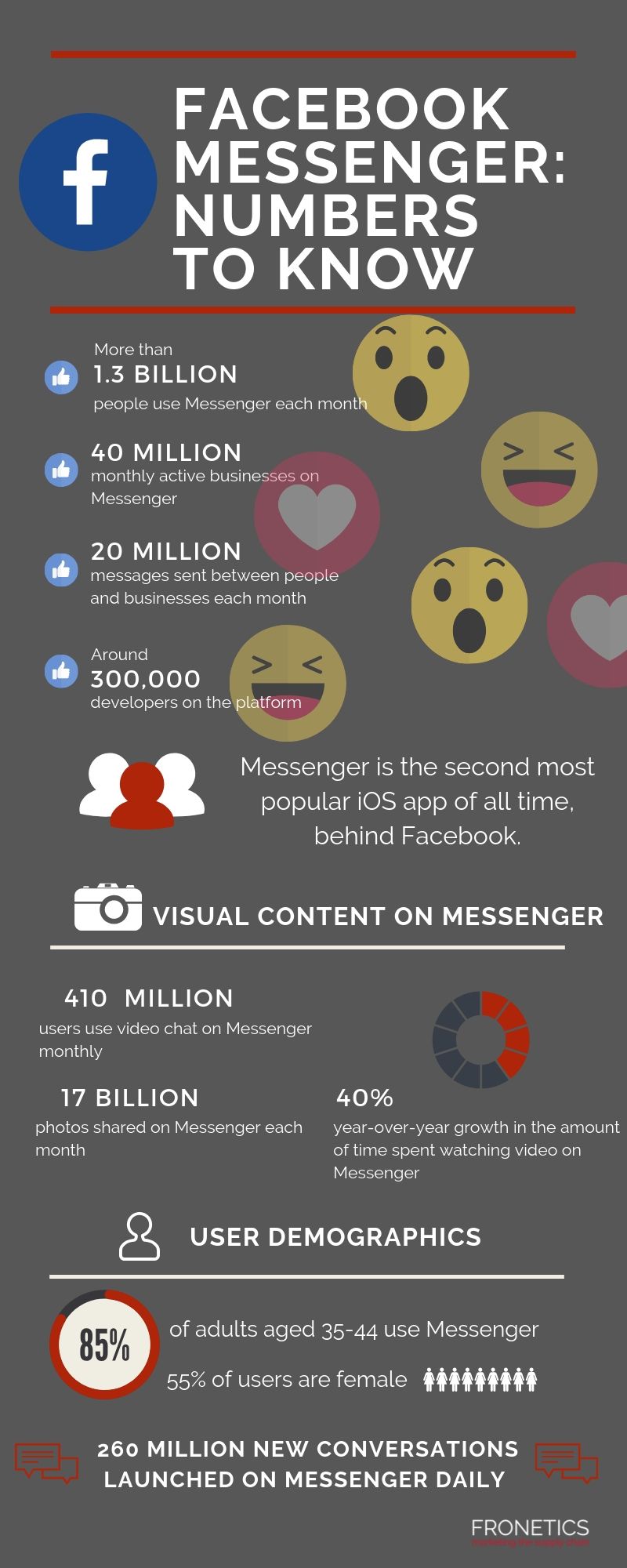
(Made with Canva)
Final thoughts
What was once thought of a teen social app, Facebook Messenger is now dominating the business world with increasing popularity and no sign of slowing down. In fact, we as a brand have found huge success using Messenger to engage with new leads. In the first 24 hours of using the platform, we were able to set up a meeting with a new prospect. That was just in the first 24 hours. This prospect turned out to be our next client, and the initial connection was all made through Facebook Messenger.
Related posts:


by Elizabeth Hines | Oct 17, 2019 | Blog, Marketing, SEO
Search intent looks at the ‘why’ behind a search. If you’re looking to improve your website ranking, here’s how search intent affects SEO.
Highlights:
- If you truly want to rank at the top of search results, you’ve got to shift your thinking in terms of topic clusters.
- Think about your buyer personas. What kinds of queries they’re typing into Google – not just the actual words but the intent behind the keywords?
- Then start creating content to answer those questions in different formats like video, blog, and infographics.
Video transcript:
I’m Elizabeth Hines from Fronetics, and today’s topic is search intent and how it affects SEO.
I keep saying that trying to rank for certain keywords is a really outdated method of SEO. If you truly want to rank at the top of search results, you’ve got to shift your thinking in terms of topic clusters. And you should develop those topic clusters based on something called search intent.
Now search intent is the why behind a search query. What that means is why did the person conduct this search in the first place. There are 4 types:
- Informational: when a user is searching for specific information.
- Navigational: when a user is looking for a specific website
- Transactional: when a user is looking to make a purchase.
- Commercial investigation: when a user is researching products or services but they’re not yet ready to make a purchase. They might be looking for reviews and comparisons.
So, how can you optimize your website to better serve search intent?
Think about your buyer personas. What kinds of queries they’re typing into Google – not just the actual words but the intent behind the keywords? Are they trying to solve a problem, like, how can I extend battery life on my forklifts? Are they trying to understand how new federal regulations or mandates might impact their business? Or, are they trying to budget for a new solution and researching pricing?
The next step is creating content to answer those questions. Try answering the question in several different formats — long-form content, blogs, video, infographics. Creating this like of content with search intent in mind is more likely to get you ranking higher in Google search results than thinking about individual keywords and phrases.
For more information, visit us at our website at fronetics.com.
Related posts:

by Elizabeth Hines | Oct 15, 2019 | Blog, Content Marketing, Manufacturing & Distribution, Marketing, Supply Chain
The analog supply chain model is outmoded and inefficient. Here’s how digital transformation is reinventing manufacturing.
Highlights:
- Manufacturers are increasingly adopting artificial intelligence and machine learning technologies.
- The traditional analog supply chain model is unable to compete with digital disruptors in a volatile market.
- Digital transformation empowers manufacturers to create sought-after personalized experiences for buyers.
Digital transformation isn’t just the latest buzzword in supply chain circles. It’s an ongoing trend that’s revolutionizing manufacturing and supply chain efficiency. According to a recent report from Accenture, 78% of CFOs are spearheading initiatives to improve efficiency through adoption of digital technology.
Digital transformation empowers manufacturers to meet the evolving demands of a customer base with rising expectations for customer service. The digital technologies that are emerging today offer analytics that are vital for forecasting and understanding how to shift the balance of supply and demand.
3 ways that the analog supply chain model is outdated
Supply chain management expert Frank Meerkamp writes, “The traditional supply chain is a tapestry built on an outdated analog network – yet it exists in a digital world.” The difficult truth is that in today’s climate of rapidly shifting market demands and an increasingly interconnected world, manufacturers must embrace digital transformation or be left behind.
Before we look at how digital transformation can benefit manufacturers, let’s take a moment to examine the challenges presented by an outdated analog supply chain.
1) Market volatility
Today’s markets move at a breakneck pace. Thanks to a constantly shifting geopolitical landscape, changing regulations and sanctions, and the unpredictability of cost and supply, manufacturers face market volatility, uncertainty, and a high level of risk. The analog supply chain model leaves companies without the agility to respond and pivot quickly and to operate efficiently on a global or regional scale.
2) Competition from digital disruptors
Perhaps the most powerful example of the way in which digital disruptors are challenging legacy leaders is the Amazon effect. Amazon has effectively situated itself as an innovator and easily has outpaced rivals in multiple sectors. Companies that continue to embrace an analog supply chain model simply cannot compete with those that have fully embraced digital transformation.
3) Rising customer expectations
While it can be tempting for B2B companies to bury their heads in the sand, believing that digital marketing is purely a B2C necessity, the reality is that supply chain companies must embrace digital marketing as part of their digital transformation. Buyers expect hyper-personalized experiences, as well as customized products, and the kind of execution that’s impossible for manufactures to deliver within the analog supply chain framework.
4 ways digital transformation addresses today’s challenges for manufacturers
As the complexity of the supply chain increases, embracing digital transformation is the clearest path to success for manufacturers. While companies that cling to an outdated analogue model struggle with eroding margins and an inability to compete, those that establish “a data-driven supply chain,” writes Meerkamp, “can gain advantages in increased forecasting accuracy, identifying and resolving issues in real time, creating new segmentations, and delivering on consumer requirements with speed, specificity, and scale.”
In short, digital transformation uses data to drive visibility and agility for manufacturers, allowing them to operate efficiently and profitably.
1) Establishing visibility and centralized control
The AI and machine-learning technologies available today enable manufacturers to meet the challenges presented by an increasingly complex supply chain. Massive sets of data can be captured and processed, providing invaluable real-time visibility. Not only that, but manufacturers can leverage this visibility to centralize data and decision-making.
2) Creating new performance engines
Thanks to the ability of AI technologies to process enormous quantities of data, digital transformation enables “powerful resolution engines, based on real-time root-cause analyses, to automate the execution of supply chain functions, and optimize transactions to meet strategic objectives,” says Meerkamp. These technologies facilitate the forecasting and immediate decision-making necessary for manufacturers to operate efficiently.
3) Facilitating agility
Today’s marketplace moves faster than ever, and market forces are constantly shifting. Agility has never been more important for companies to compete. Intelligent technologies allow supply chain companies to establish a management model that is collaborative, data-driven, and platform-based. Digital transformation enables the sharing of qualitative information as well as real-time data and implications. This in turns enables agile management, ready to meet the shifting demands of the marketplace.
4) Developing personalization and flexibility
One of the biggest challenges manufacturers face today is the increasing buyer expectations of personalized experiences. AI technology enables the creation of segmentation strategies, addressing buyers’ personalized needs based on various factors, including channel, location, and service level. Real-time visibility into market data also leads to greater insight into buyers’ needs and how to meet them.
Organizations that embrace digital transformation are empowered to create personalized experiences for their customers and operate with the agility, visibility, and centralization necessary to compete in today’s marketplace.
Related posts:

by Elizabeth Hines | Oct 4, 2019 | Blog, Current Events, Logistics, Marketing, Social Media, Supply Chain
Also, this month in social media news: a court rules LinkedIn cannot stop third-party scraping public information and Facebook expands “Today In” section.
After a relatively quiet month in the world of social media news, social platforms have been hard at work making changes to provide a better user experience and cut down on spam accounts. This is good news for B2B marketers looking to stand out amongst all the competition.
With the growing influence of social networks, social channels have been challenged with making sure the information shared on their sites is authentic and “real” news. In response, social platforms have been working to sort through fake accounts and streamline ways to detect and remove these accounts, which often result in major losses of followers.
But this decline in user accounts does not mean that social media platforms’ influence is declining. In fact, social media usage is at an all-time high, and networks are pushing out new updates, features and policies to keep users happy.
Here’s your social media news for October 2019.
Facebooks announces new business tool for Messenger
Looking to increase leads and engage with new audiences? Facebook is trying to help. The social network introduced a new package of tools for the 40 million active businesses on Messenger, including booking appointments and lead generation workflows. As the new features were announced, Facebook also reported the Discovery tab will be phased out. According to Facebook, “Businesses engaging with potential leads in their preferred channel are seeing results, and finding it easy to continue the conversation and seamlessly nurture leads in Messenger.”
Twitter tests new ‘topics’ shortcut
Twitter users may soon be able to follow topics in the same way they would follow users. Users can see tweets about topics they choose (like digital marketing, supply chain procurement, or even sports) in the home feed. Individual tweets will be monitored through machine learning and chosen to be included in specific topics.
Though only in the testing phase, the new shortcut would help users discover the exact content they need and want without following a specific account. The Verge reports that Twitter is also working on other ways to improve the user experience, including searchable direct messages, the ability to re-order the photos in a tweet after you have attached them to a new post, and plans to add support for Apple’s Live Photos.
Court rules that LinkedIn cannot stop third-party data scraping of public information
hiQabs has been collecting public user information on LinkedIn to create analytics for employers that accurately identify employee patterns and help with retention efforts. But LinkedIn has tried to block the “data scrapping,” alleging that hiQ was violating the CFAA, as well as the Digital Millennium Copyright Act (DMCA).
Until now, when a San Francisco appeal’s court told LinkedIn to take a step back. The court’s decision means the CFAA doesn’t apply to public information, including information collecting via social media platforms. This decision could have major implications for social platforms looking to protect user privacy. We’ll continue to closely monitor any updates from this case in next month’s social media news.
Facebook expands “Today In” section
“Today In” has been running in six U.S. cities since January 2018, and has over 1.6 million people who have opted to receive regular local updates from Today In within the newsfeed. Facebook just announced they’ll be expanding the news section to 6,000 more U.S. cities and towns, bringing local news to “news deserts,” areas with limited local news available.
“Today In” showcases the biggest news stories and happenings in local regions. With declining engagement rates, Facebook created the separate newsfeed in an effort to boost engagement and discussions around topics that matter to local areas.
Facebook clarifies privacy settings for Groups
Public, closed, or secret? What do these privacy settings mean? Users across Facebook’s platform weren’t sure, so the network has changed the wording describing the privacy settings for groups. To make these settings clearer, groups now have the option of public or private. Facebook writes:
“We’re making this change because we’ve heard from people that they want more clarity about the privacy settings for their groups. Having two privacy settings — public and private — will help make it clearer about who can find the group and see the members and posts that are part of it. We’ve also heard that most people prefer to use the terms “public” and “private” to describe the privacy settings of groups they belong to. “
The changes leave privacy settings more straight-forward. Public groups show anyone who is a member and all the content shared within the group, while private groups will only show members and content to users that join the group.
Related posts:
by Elizabeth Hines | Sep 26, 2019 | Blog, Current Events, Marketing, Social Media
Having the right social media image sizes for each platform is a key part of creating visually appealing posts.
Highlights:
- Each social media platform has its own set of image guidelines.
- Choosing the right social media image sizes ensures that your content is as visually appealing as possible.
- We like Canva Pro for quick resizing of images and graphics.
Social media is all about the visual. Whether it’s Instagram, Facebook, Twitter, or LinkedIn, having the right image can make or break the effectiveness of a post. Social media image size might seem like a relatively unimportant facet of choosing an effective image for a post. But you might be surprised to discover how important it can be.
An incorrect social media image size can make your post less visually appealing than it could be, and it can even erode how the number of impressions a post receives. Because each platform has its guidelines for sizes — and because each image type (profile picture, cover photo, etc.) has different size restrictions — determining correct social media image size is no easy task.
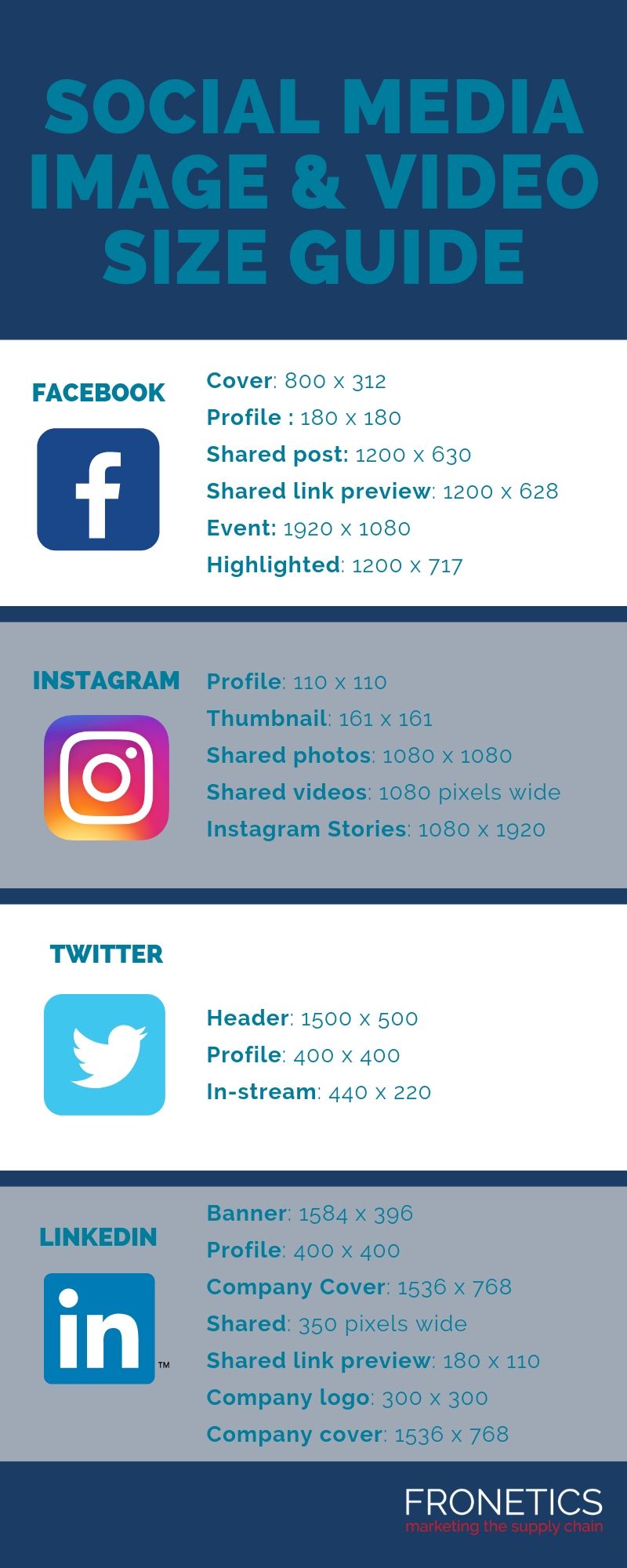
The infographic below gives you a complete guide to the various image size requirements on Facebook, Instagram, Twitter, and LinkedIn. Once you know the correct social media image sizes, you can set your photo editing software to the correct dimensions.
Social media image sizes: by the network
(Made with Canva)
Facebook
Facebook is perhaps the crown jewel of social media platforms, boasting 1.5 billion daily active users. While the platform is text-friendly, images are key to creating engaging content on the platform. An important thing to remember when it comes to images on Facebook is that they will display differently on your page’s timeline as compared to a user’s newsfeed. This means that your choice of image dimensions should be based on where you want your viewers to see your image.
Image dimensions:
- Cover image: 800 x 312
- Profile image: 180 x 180 (though it will display as 170 x 170 on desktop, and 32 x 32 as a thumbnail)
- Shared post image: 1200 x 630
- Shared link preview image: 1200 x 628
- Event image: 1920 x 1080
- Highlighted image: 1200 x 717
Instagram
Instagram is all about the visual – which means that it’s crucial that your brand’s presence on the platform is driven by high-quality images. As a rule, the platform scales down photos to 612 x 612, but it’s still recommended that shared images be set to 1080 x 1080 to optimize quality.
Image dimensions:
- Profile image: 110 x 110
- Image thumbnail: 161 x 161
- Shared photos: 1080 x 1080
- Shared videos: 1080 pixels wide
- Instagram Stories: 1080 x 1920 (minimum 600 x 1067); maximum 4 GB
Twitter
Twitter has 313 billion monthly active users and has recently updated its image guidelines.
Image dimensions:
- Header image: 1500 x 500; maximum 5 MB
- Profile image: 400 x 400; maximum 2 MB
- In-stream image: 440 x 220
LinkedIn
While the network may not be thought of as a highly visual platform, images on LinkedIn make a big difference in terms of post engagement. With 467 million registered users, it’s the world’s largest professional network. Having polished, well-sized images on the platform can go a long way toward maximizing its potential for professional networking and industry visibility.
Image dimensions:
- Banner image: 1584 x 396; maximum 4 MB
- Profile image: 400 x 400 (minimum 200 x 200); maximum 10 MB
- Company Cover image: 1536 x 768
- Shared image: 350 pixels wide
- Shared link preview: 180 x 110
- Company logo image: 300 x 300; maximum 4 MB
- Company cover image: 1536 x 768 (minimum 1192 x 220); maximum 4 MB
- Company page banner image: 646 x 220; maximum 2 MB
- Square logo (appears in company searches): 60 x 60; maximum 2 MB
An insider trick for quick and easy resizing
As you can see, there is quite a bit of variability in social media image sizes. You could spend hours resizing graphics or images for the same post across multiple platforms… Or, you could do what we do, and try a design platform like Canva. Not only does it already have all the proper dimensions available as templates, Canva Pro lets you change the size of graphics you created in a single click. It definitely makes life a lot easier.
Related posts: