by Elizabeth Hines | May 23, 2018 | Blog, Content Marketing, Logistics, Marketing, Strategy, Supply Chain
If you’re hoping to generate more leads on your website, you’re going to have to develop a holistic content strategy and create many strong calls-to-action.
You may have read part one of this mini-series about the importance of having a solid website if you’re going to invest in content marketing. Essentially, there’s no point in pouring a bunch of time, money, and resources into a robust content marketing program if the website that you’re driving traffic to stinks.
Be thoughtful about the role your website plays in the lead-generation process. It’s a really important piece of the puzzle that companies often overlook.
Consistently producing quality content and distributing it through various channels, like social media, will help attract your target audience to your website. But unless you provide them with a good user experience while they’re there — and give them plenty of opportunity to opt in to learn more about your business — you’re not going to move them down the sales funnel. And you’re not going to generate more leads on your website.
So how do you ensure your website is a lead-generating machine? Here’s what I know.
5 tips to generate more leads on your website
1) Create a holistic content strategy.
I can’t overstate the importance of creating a content marketing strategy, documenting it, and then designating someone to lead it if you want your content marketing to be successful. As part of that strategy, you should outline the role your website will play in assisting the conversion of leads.
Ask yourself these questions:
- Do different pages of my website suit prospects at different stages of the buyer’s journey?
- Where do I want traffic to go from each page (so prospects move further down the funnel)?
- What calls-to-action can I add to each page to assist them in that move?
- Which pages are ripe for lead conversion, and which are better for providing information?
- If you’re using the topic cluster model (which you should be!), where are my pillar pages and corresponding topic cluster pages?
Also, make sure your messaging is consistent across your website and your regularly published content (like blog posts).
2) Think about the user and how s/he experiences your site.
Hopefully in creating a holistic content strategy that includes your website, you’re thinking primarily about how the user will be interacting with your site and each page. That means organizing pages in a way that makes sense for the prospective customer, rather than internal politics.
That sounds easy, but I have helped many organizations for whom this is incredibly challenging. Often, one department (or person) feels strongly that something very important to them deserves real estate on the homepage or in the main navigation. But, if it’s not something that is meaningful to a prospective customer, you’d best not cave. Doing some usability testing with prospects is a good way to collect data to support your reasoning.
Also to consider: think about the language your buyers are comfortable with, and avoid any overly jargony or technical wording. Make sure to lay things out in a way that is approachable for them. And aim to provide the information they seek, rather than trying to sell them at every step.
3) Publish original, quality content.
Along those same lines, the best way to convince today’s B2B buyer to choose you as a vendor is to win them over with your content. Content marketing is all about positioning yourself as an expert in the industry, after all, the business that knows the most about your product/service.
Instead of promoting your business on every page, use each as an opportunity to showcase your expertise. Create resources that will help buyers better understand how to solve their pain points. And make sure everything you publish is well-written, offers value to prospects, and is completely original. You want people to want to read what you have to say.
Consider incorporating various content formats to cater to different learning preferences:
- In-depth blog posts and articles
- Infographics for visual learners
- Short video tutorials or explainers
- Podcasts for those who prefer audio content
4) Strategically place strong, visible calls-to-action.
I’ve hinted at this one already, but it bears further explanation. Make sure your website is full of calls-to-action, or buttons/links/forms that ask visitors to do something further. After all, how do you expect someone to take an action (like providing their email address) if you don’t ask them to do it?
You can generate more leads on your website by asking visitors to become leads more often.
Make sure these calls-to-action stand out on the page so that visitors’ eyes naturally go there. Be very clear about what you’re asking for and/or what the user will get in return when they complete the action. And, again, be strategic about what you’re asking people to do on which page. You won’t have much luck, for example, asking visitors to call a sales rep on a page that is designed to assist them with initial information-gathering.
Pro tip: Use A/B testing to optimize your CTAs. Try different colors, copy, and placements to see what resonates best with your audience.
5) Offer value with your calls-to-action.
Sometimes it might take a little convincing to get visitors to provide their contact information. The best way to persuade them? Give them something they want in exchange.
We call this high-value content. Examples might include:
- Case studies
- White papers/industry reports
- Webinars
- Tutorials or how-tos
- Demonstrations
- Sneak peaks or previews
- Guides or ebooks
- Podcasts
Ask visitors to download your high-value content by completing a form, which asks for their email address. Set up your marketing automation to email the content to them, then send a series of lead-nurturing emails following up at strategic intervals to keep them moving down the sales funnel.
If you want to generate more leads on your website, follow these five steps. Above all, just be thoughtful about the role your website plays in the lead-generation process. It’s a really important piece of the puzzle that companies often overlook.
Related posts:

by Elizabeth Hines | May 14, 2018 | Blog, Content Marketing, Logistics, Marketing, Strategy, Supply Chain
Here are 4 ideas for measuring podcast success, including downloads, audience, lead tracking, and intangible benefits.
Podcasts are an increasingly popular content medium, but measuring their performance is difficult. Here are some tips for measuring podcast success in spite of the challenges. Spoiler alert: it’s an art, not a science.
Why podcasts?
Today’s busy professionals are increasingly driven to make their “down time” more productive and engaged. The popularity of podcasts rises every year, with more than 50% of American homes now classified as “podcast fans” by Nielsen.
Podcasts are easily downloadable on a phone or mobile device. They allow the user to listen to a topic of interest while commuting, exercising, or cleaning the house. Podcasts are essentially blogs in audio format, and — like blogs — they are relatively cheap to produce, making them an excellent high-value offer with which to generate or nurture leads.
If you’re already creating podcasts as part of your content program, good for you! But, you’re probably running into a familiar challenge: It’s really hard to measure podcast performance.
4 tips for measuring podcast success
ROI calculations for podcasts are notoriously elusive because users download them on their devices. Producers won’t know whether a user ever listened to any or all of a particular podcast.
But measuring podcast success is possible, at least for those that don’t mind a little more nuance than numbers. Here are 4 tips to get you started.
1) Track unique downloads
With podcasting, the best measurement is something called a “unique download,” which tries to capture how podcasts are generally obtained. It measures a progressively downloaded file by a single user at a single IP address over a 24-hour period. Third-party tracking services like PodTrac or tracking/hosting services like Libsyn or Podbean can give you this information.
Is this perfect? Nope! Users can download and never listen or download and only partially listen. Multiple users can listen to one download, and one user can download twice (or more) onto multiple devices. There is nothing exact about tracking the number of unique downloads. But based on the way podcasts are consumed, it’s not a bad metric, and frankly, it’s all we’ve got.
2) Estimate your base audience
Determining the approximate size of your subscriber list — or at least your committed and consistent listening audience — is also helpful. This isn’t exactly the same as unique downloads. Subscribers are people that have gone out of their way to make sure to be alerted when you publish a new podcast.
To do this, examine two trends: the consistency in unique downloads across multiple episodes and, more importantly, the number of downloads in the first 48 hours after a new release. Those first few days are when your consistent listeners will grab the industry-fresh (you hope!) info, and it will give you sense of how big that segment is.
These subscribers are your bread and butter. And you can use this number, albeit approximate, as you would other marketing metrics that measure engagement.
3) Get creative (without getting annoying)
If getting a better sense of lead generation from your podcasts is imperative, try thinking creatively about how to access that information from your audience. But beware! The more you require of your listeners, the more annoying you potentially become. That said, here are some ideas.
- Create a page/section on your website where visitors can access the podcast. If you’re using a marketing software like HubSpot, you’ll be able to tell if leads access this via your site.
- Add an optional question on the lead-generation forms on your website, just a simple checkbox like, “Have you heard our podcasts?”
- Check the previous page path from your homepage on Google Analytics or your referrals sites report from software platforms like HubSpot for traffic coming from podcast websites.
- Create a special landing page and mention it as a call-to-action in your podcast several times. This way, you know any traffic visiting this page must have come through the podcast.
All these can offer a rough (but low) estimate of leads that have consumed podcast content.
4) Remember the value of intangibles
Here’s the part where we remind you how important it is to remember why you are podcasting. Lead generation? Of course. But why else? We’d venture to say building relationships, like all of your content marketing. Podcasts are wonderful for this!
Invite your current customers or best business relationships to join you for a podcast. There’s a lot of power in a really good interview on a podcast: You get some fresh and new content; you deepen a potentially very useful business relationship; and you gain their network of listeners, too.
Learn from the inconsistent
Patterns and consistency can give a broad sense of the success of your podcasting. But don’t forget to abandon them sometimes, particularly if there is one podcast that’s an outlier.
If one was wildly successful, that’s fantastic. Chances are you hit on an extremely timely topic, or perhaps did something better in your efforts to share outside of your base subscriber list. Great news for your lead-generation efforts!
That said, if you have one or two that garnered lower interest, don’t assume the opposite is true. And don’t let them skew your broader analysis. Sometimes it only has to do with how niche your topic was, and niche topics can still be highly successful lead-generation tools, particularly if yours is a niche business with niche clients. In fact, these niche podcasts may end up being some of your most successful.
Related posts:


by Elizabeth Hines | May 9, 2018 | Blog, Content Marketing, Logistics, Marketing, Strategy, Supply Chain
A webinar is an excellent content medium to generate leads to or nurture those already in your sales funnel.
Maybe you’ve taken a webinar to enhance your professional skills. Did you know that webinars can be beneficial not only to the students, but also to the business providing them?
In content marketing, we consider a webinar content that your target audience will find valuable. You can leverage this value to move them through the buyer’s journey — whether it’s becoming a lead by providing their contact information in exchange for attendance, or by using the webinar strategically in the lead-nurturing process.
What content should I use in my webinar?
In a recent interview, Amy Porterfield, online marketing expert and the host of Online Marketing Made Easy Podcast, shares her ideas about what content should be part of a webinar and what webinars should sell.
Porterfield suggests that live online workshops and pre-recorded courses sell well in a webinar, whereas physical products are less effectively sold in this format. “So before you choose a webinar to sell your product or service, think about how the thing you’re selling is or isn’t like a webinar experience.”
How is a webinar different from my other content?
What separates your free content (like blogs, social media, podcasts, etc.) from paid content like a webinar?
Porterfield emphasizes that, while free content explains the “What” of your products and services, “your paid content explains the How.” She suggests that a successful webinar will “paint a picture using images and really powerful words and stories.”
Your attendees should leave the webinar feeling that they’ve learned something valuable, and that they are ready to take the next step — which should be considering your product or services. “When you begin selling in your webinar, focus on how your paid program, online product, consulting, or coaching helps attendees achieve the opportunity, transformation, or result you’ve just explained,” says Porterfield.
She also suggests bringing your target audience’s obstacles to the forefront of the conversation. “Clearly articulating the obstacles lets your audience understand them on your terms and creates a well-defined pathway for your product or service to help them overcome the obstacles. Essentially, you want to provide enough information so that your product is the next logical step.”
Have you tried creating a webinar?
Related posts:


by Elizabeth Hines | May 3, 2018 | Blog, Content Marketing, Logistics, Marketing, Social Media, Strategy, Supply Chain
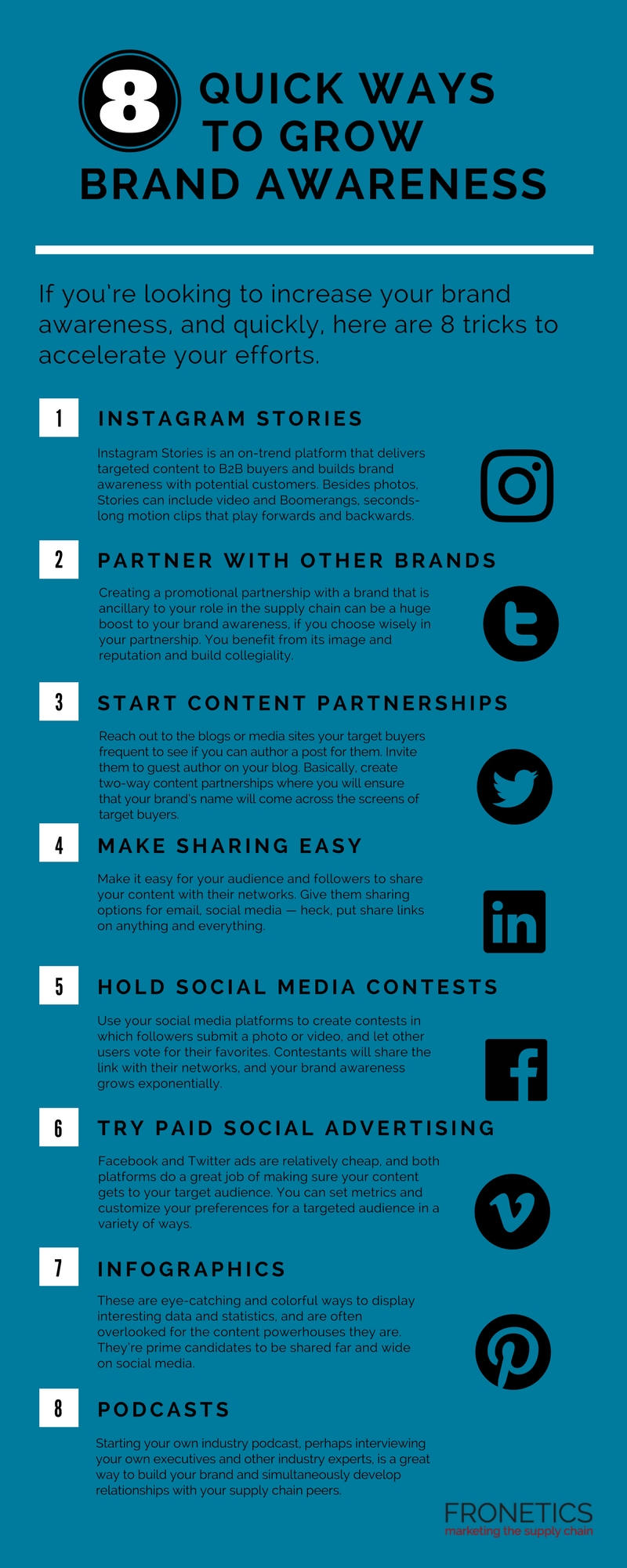
If you’re looking to grow brand awareness fast, here are 8 tricks to boost your efforts.
Have you ever noticed how some brands seem to have crept into popularity overnight? You’ve never heard of them, and then, all of sudden, they’re everywhere.
Their brand awareness has sky rocketed, and they’re achieving every company’s ultimate goal: Customers know about them. So what’s their secret?
Here at Fronetics, we don’t believe they have a secret. We believe that they took advantage of content marketing and its many benefits — growing brand awareness included. They were able to scale their growth in a short amount of time, a true success story for the digital era. Companies like Uber and Yelp have used these tips to implement small changes that yielded large results.
Remember, in order to grow brand awareness, you need to be proactive. It’s time to steer away from some of the traditional marketing methods, which don’t take into account how modern B2B buyers research vendors. Start putting your content marketing strategy to the test.
If you’re looking to increase your brand awareness fast, there’s no better place to start than with content marketing. Check out these 8 tips for using content marketing to grow your brand awareness fast.
Infographic: 8 ways to grow brand awareness fast
(Made with Canva)
How do you grow brand awareness fast?
Related posts:

by Elizabeth Hines | Apr 11, 2018 | Blog, Content Marketing, Logistics, Marketing, Social Media, Supply Chain
Updated December 5, 2024
Today’s B2B buyer’s journey involves more internet research and more social media use.
The B2B buyer’s journey has undergone a dramatic transformation, driven by digital innovation and changing buyer preferences. Research from Gartner shows that B2B buyers now spend only 17% of their total purchase journey time meeting directly with potential suppliers. Instead, they dedicate 27% of their time researching independently online.
Key Trends Shaping the B2B Buyer’s Journey
Digital-First Research Phase
According to TrustRadius’ 2023 B2B Buying Disconnect report, 87% of buyers want to self-serve part or all of their buying journey. This shift toward digital self-service has fundamentally changed how B2B companies must approach their marketing and sales strategies.
The Rise of Multi-Channel Engagement
Recent data from McKinsey (2023) reveals that B2B buyers regularly use ten or more channels throughout their purchase journey, compared to just five channels in 2016. This multichannel approach includes:
- Online research and comparison tools
- Social media platforms
- Peer review sites
- Virtual product demonstrations
- Video content
- Interactive webinars
The Impact of Peer Influence and Social Proof
LinkedIn’s State of B2B Marketing report highlights that 84% of B2B buyers are more likely to purchase from vendors recommended by their professional network. This emphasis on peer validation has made social proof and customer testimonials more crucial than ever.
Adapting Your Strategy to the Modern Buyer’s Journey
Content Personalization and Industry Expertise
Recent research by Salesforce indicates that 76% of B2B buyers expect vendors to understand their business needs and industry challenges specifically. This demands:
- Industry-specific content creation
- Personalized solution recommendations
- Targeted thought leadership content
- Custom ROI calculations
The Role of Digital Content in Decision Making
Content continues to play a pivotal role, but its format and delivery have evolved. According to HubSpot’s 2023 State of Marketing Report, the most effective content types now include:
- Video content (preferred by 91% of B2B buyers)
- Interactive tools and calculators
- Case studies and success stories
- Industry research and original data
- Expert webinars and virtual events
Strategic Implications for B2B Companies
Understanding the modern B2B buyer’s journey is crucial for optimizing marketing and sales efforts. Companies must:
- Invest in robust digital presence across multiple channels
- Create high-quality, industry-specific content
- Leverage social proof and customer testimonials
- Provide self-service information and tools
- Maintain consistent omnichannel engagement
The B2B buying process hasn’t necessarily shortened, but it has become more complex and digitally oriented. Success requires adapting to these changes while maintaining focus on delivering value throughout the buyer’s journey.
Infographic: the B2B buyer’s journey
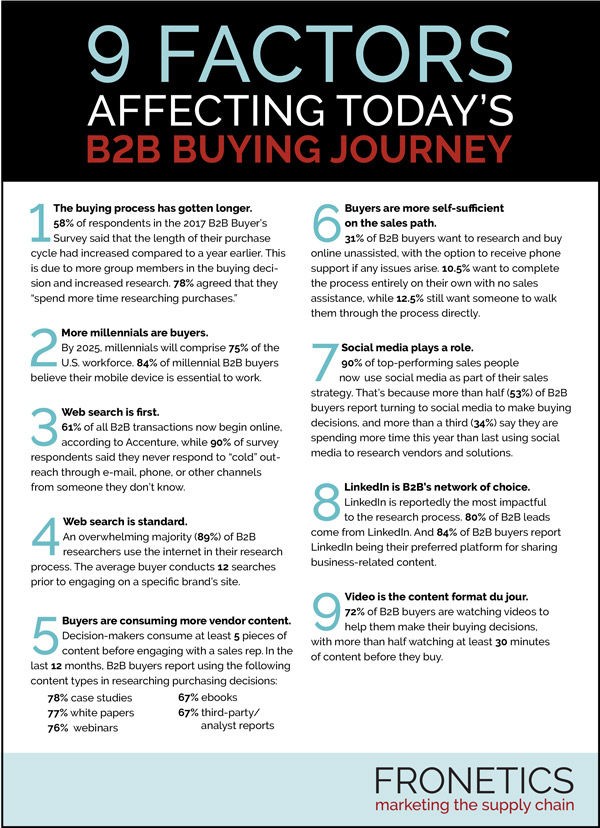
The B2B buyer’s journey continues to evolve with technological advancement and changing buyer preferences. Companies that understand and adapt to these changes – by providing comprehensive digital resources, personalizing content, and enabling self-service options – will be better positioned to attract and convert modern B2B buyers.
Related posts: