by Fronetics | Feb 26, 2015 | Blog, Marketing
Different marketing efforts produce different customer conversion rates. Here’s what you need to know so you can maximize your marketing efforts.
Deciding where to focus your company’s marketing dollars to attract leads and convert them into customers can be a tricky endeavor. The key to a successful marketing strategy requires evaluation beyond what’s anecdotally “working” to a more evidence-based approach. Here we pull the curtain back to reveal how certain marketing activities stack up against one another when it comes to customer conversion rates.
Tradeshows
While tradeshows continue to be a staple of most marketing departments in the logistics and supply chain industries, the return on investment can be disappointing. Implisit reports the average opportunity to customer conversion rate for all marketing channels to be 48%, but less than 30% of opportunities generated by tradeshow activity are converted into customers. Tradeshows don’t have to be a total bust, though. Turn tradeshow activities into robust lead nurturing campaigns and use social media to keep the conversation going with customers and prospects. Use your company blog to dig deeper into the issues your prospects had and turn their questions into answers addressed in-depth in blog posts. By driving tradeshow activity back to your company blog and social media accounts, you create more intimate, meaningful relationships with prospects that are far more likely to result in customer conversions.
Lead Lists
Conversion rates for lead lists are among the poorest for all marketing activities. In addition to being one of the highest cost per lead marketing approaches, lead lists can damage the credibility of marketers with target prospects and email service providers alike. Akin to a credit score, marketers who use email to reach prospects should protect the credibility and reputation of their email sender score. If you load up emails and blast them out to anyone and everyone like you would a t-shirt gun at a basketball game, your score will suffer and future emails will be less likely to reach their intended recipient. Similarly, sending generic, uninspired emails to unsegmented lists can undermine your efforts to reach high-value prospects. Work smarter with your lead lists by creating highly segmented mini-lists. Send relevant and specific material to each segmented list. Building hyper-focused lead nurturing campaigns and creating real value for 250 leads is much more likely to generate real opportunities than sending 500 leads a groan-inducing, delete-immediately email.
Webinars
On the surface, webinars seem to pack a big punch for marketers. Having a captive audience in front of which to visually promote your services or products is what marketers live for, right? Not exactly. When it comes down to closing deals and winning customers, webinars don’t live up to expectations. In fact, less than one third of webinar-generated opportunities will convert to customers. One reason for such a meager conversion rate is that most marketers tend to hold webinars as a one-off product or service promotion. Trying to produce a speedy sale by presenting and closing with a webinar turns leads cold or worse, closes deals with customers who aren’t a good match for your products or services. Building a solid, lead nurturing webinar strategy can improve your conversion rates for this marketing channel. Creating a webinar funnel and aligning webinar topics to lead positioning within the funnel builds rapport and ensures your company has the attention of the right audience.
Websites
Leads generated via a company’s website not only have a higher than average lead-to-deal conversion rate (1.5%), but also a faster average time to closing. Other marketing channels – email marketing, social media, print – often link back to a company’s website where the actual conversion will take place. Because of this, special attention should be given to the wording of calls to action, the formatting, and the ease of use of your website. Further, a robust, consistent publication and distribution strategy for website content and resources will ensure the return of visitors and increase opportunities for lead and customer conversions.
Social Media
HubSpot reports that social media has a 100% higher lead-to-close rate than outbound marketing, making it a worthwhile marketing activity for many companies. Social media allows for a more personal and nimble engagement with leads and prospects. Optimize your lead and customer conversion rates via social media by aligning content with platform etiquette, encouraging the promotion of your content by making it easy for followers to share your resources, and not limiting your engagement to leads and prospects.
Surprisingly, marketing activities that generate the most leads often don’t produce the best conversion rates. Do you see that reflected in your own marketing efforts? Which marketing channels have proven the most successful for your company?

by Fronetics | Feb 18, 2015 | Blog, Content Marketing, Marketing, Strategy
Content curation is an essential component of a marketing strategy.
When it comes to creating and executing a successful marketing strategy, content curation is often forgotten. There are two reasons for this: 1) lack of knowledge about what content curation is; and 2) lack of knowledge about the role of content curation within a marketing strategy.
Here is what you need to know about content curation.
What is content curation?
Simply put, content curation is the act of identifying valuable content from a variety of sources and distributing via it your own platform in a strategic manner.
Heidi Cohen, President at Riverside Marketing Strategies, looked to content marketing experts so as to better understand what content curation is and how it can be used to achieve business objectives. She compiled 19 definitions. Here are three of the definitions:
Content curation is the process of identifying content created by others that will be valuable for your audience and then publishing it on your own platform. Michael Brenner of SAP and the B2B Insider blog.
Content curation is hand selecting content created by other sources and sharing them with your community. Best done when whoever is curating adds their own explanation for sharing, reaction or opinions. C.C. Chapman author of Author of Amazing Things Will Happen and co-author of Content Rules.
Content curation is the process of choosing the most relevant information to meet your readers’ needs on a specific topic like a good editor or museum curator. Content curation requires more than just the selection of information. It’s the assembling, categorizing, commenting and presenting the best content available. Heidi Cohen of Riverside Marketing Strategies.
Why content curation matters
A 2014 survey found that 76% of respondents reported that content curation positively impacted their business goals in 2013. 90% of respondents predicted that content curation will have a positive impact on their business goals in the upcoming year.
No one wants to hear about you all the time. As strange as it may sound, talking about your products, services, and your value all the time is bad for business. Here is where content curation comes in. Content curation will serve to establish your business as a thought-leader within the industry and as a trusted resource. Additionally, it will serve to increase your brand visibility. The great thing about content curation is that it enables you to achieve these business objectives without talking all about you.
Navigating the deluge of digital content available, and identifying the content that is relevant and valuable to your prospects and customers is critical.
Two things to remember:
Quality is key
There is a lot of digital clutter. Steller content curation sorts through the clutter and identifies quality content. Make sure that the content you curate is quality content and not clutter.
Be valuable and relevant
Make sure that every piece of content your curate is content that is both valuable and relevant to your prospects and customers.

by Fronetics | Feb 5, 2015 | Blog, Logistics, Strategy, Supply Chain

Think inbound marketing isn’t for the supply chain and logistics industries? Guess again. Here are 5 reasons companies in the supply chain and logistics industries need inbound marketing.
Companies within the supply chain and logistics industries tend to disregard inbound marketing. The reason being they do not think inbound marketing will prove successful. The common objection is that prospects and customers for these industries are not online.
The reality, however, is that inbound marketing can be wildly successful for companies within the supply chain and logistics industries.
Here are five reasons why companies in these industries should use inbound marketing:
1. Customers are online.
B2B buyers are online. 93% of B2B buyers report that they use search engines to research purchase decisions. These buyers go online for a number of reasons including to:
- Learn about new market developments and industry practices;
- Discover new solutions to address a specific problem;
- Address a project or a program being undertaken by their company.
2. 60% of the sales process takes place before they engage your sales rep.
The average customer progresses nearly 60% of the way through the purchase decision-making process before engaging with a sales rep.
Before engaging with a sales rep, customers are turning to the internet and to social media for information. The 2014 UPS B2B Buyers Insight Study found that 68% percent of buyers research supply purchases via supplier website, and 52% use search engines.
3. You can present solutions to your prospects’ problems via social media and content.
When prospects go online they are looking for information and for answers. By creating valuable content and leveraging social media you can attract and engage prospects, and convert these prospects to customers.
4. Inbound marketing is more effective than traditional marketing.
Research conducted by HubSpot found that inbound marketing is more effective than outbound marketing:
- 200% average ROI;
- 62% lower cost head;
- 15% increase in top line revenue.
5. The proof is in the pudding.
Freight logistics company Cerasis decided to make the switch from outbound marketing to inbound marketing. Within 25 months the company gained 98 new customers and increased revenue by 14%.
Fronetics Strategic Advisors is a management consulting firm with a focus on inbound marketing. We create and execute successful strategies for growth and value creation. Unlike other firms, our approach is data driven. We know ROI is important, so we track and measure results to drive success. Read about our approach to inbound marketing, or get in touch.


by Fronetics | Feb 4, 2015 | Blog, Data/Analytics, Marketing, Social Media, Strategy

Inbound marketing costs less than outbound marketing. And it works.
The internet has empowered customers. It has provided customers with new methods for finding and researching companies. It has also provided customers with new methods for finding, researching, and buying products.
The internet has changed marketing from a one way street to a two way street.
Customers no longer rely solely on TV/newspaper/magazine ads, billboards, direct mail, email, banner ads, and other traditional outbound marketing channels to learn about new products. These methods are now viewed as too intrusive, especially among younger consumers who regularly tune out the tactics.
Customers want to find YOU (not the other way around)
A study conducted by the Corporate Executive Board’s (CEB) Marketing Leadership Council found that the average customer progresses nearly 60 percent of the way through the purchase decision-making process before engaging with a sales rep. How are they able to do this? By going online. Customers are using websites, blogs, and social media.
A study by Pardot found that 72 percent of B2B buyers begin their research with Google. Other starting points for research: personal networks (15.58%), Yahoo (5.53%), Bing (2.76%), LinkedIn (2.51%) and social networks (2.01%).
What is inbound marketing?
Inbound marketing focuses on consumers finding you.
Inbound marketing meets your customers and prospects where they are, with the information for which they are looking, and at the right moment. Inbound marketing provides value, builds trust and authority, which ultimately result in increased leads and higher conversion rates.
The components of inbound marketing are pretty simple: Create and distribute fresh, relevant, targeted content specifically designed to reach a target audience.
Strategies include:
- Social media marketing
- Blogging and content marketing
- Podcasts
- White papers
- ebooks
- Infographics
- Search engine optimization (SEO)
- Case studies
What is outbound marketing?
In contrast, outbound marketing focuses on paying to broadcast your message to find consumers who will listen to you.
Outbound marketing is a value-driven numbers game. The more banner ads, print ads, and direct mailings you pay for, the more people see your product, and the more sales you’ll make. However, it is costly. Outbound marketing costs 38% more than inbound marketing. The average cost per lead using outbound marketing is $373. The average cost per lead using inbound marketing is $143.
Outbound marketing strategies include:
- Print ads
- TV ads
- Banner ads
- Telemarketing
- Cold calling
- Press releases
- Trade shows
- Email marketing
- Direct mail
Inbound marketing makes sense
Inbound marketing just makes sense. It is a proven methodology and it costs less. Isn’t it time to meet your customers where they are? Get online. Create content. Distribute content. Engage with customers. Optimize your website.
Fronetics Strategic Advisors is a management consulting firm focused on strategy and inbound marketing. When it comes to inbound marketing we take a different approach than other firms. This is because of our business experience and background. We know ROI is important, so our approach is data driven and produces results.
We understand that developing and implementing an inbound marketing strategy can seem daunting. We are here to help. We are happy to take a few minutes and look at your current strategy and give you ideas on how to start, or suggestions on what you can do to make your current strategy more successful. We are also happy to talk with you about what we can do.
We’d love to talk with you about how you can grow your business through inbound marketing.
![Why you need to understand what B2B buyers think about content [Infographic]](https://fronetics.com/wp-content/uploads/2024/10/content-B2B-buyers-643x675.png)
by Fronetics | Jan 27, 2015 | Blog, Content Marketing, Marketing
If you want to attract B2B buyers with content, you need to understand what B2B buyers think about content.
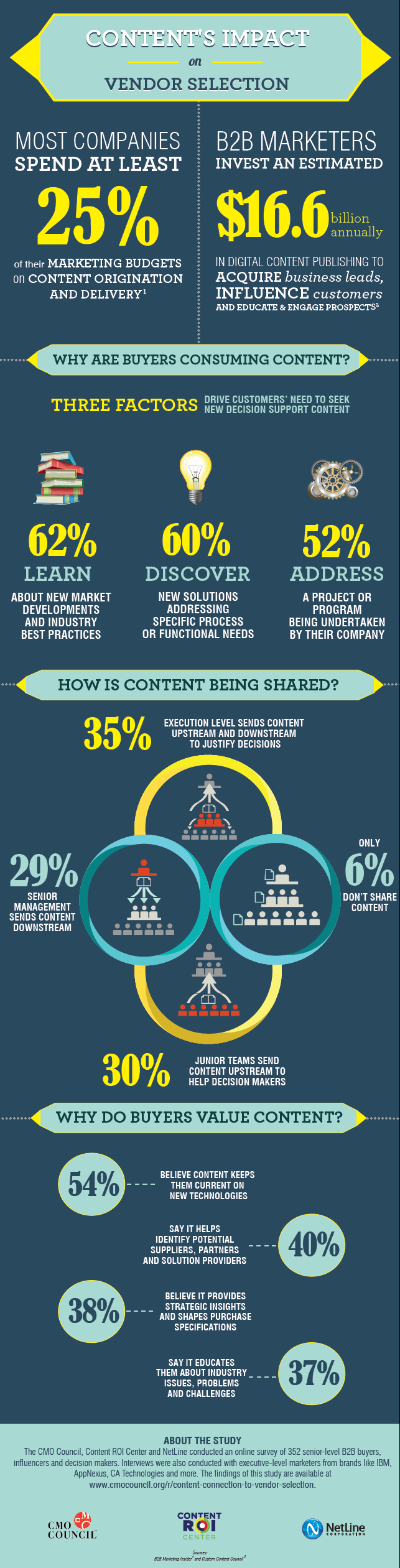
93% of B2B companies use content marketing. If you want your content marketing efforts to be effective you need to understand why B2B buyers consume and value content. When you understand what B2B buyers think about content you can create and distribute the right content – content that will help you grow your business by driving profitable customer action.
The CMO Council, Content ROI Center, and Netline conducted a survey of 352 senior-level B2B buyers, influencers, and decision makers with the objective of determining content’s role in influencing B2B buyers in the purchase process.
Why do B2B buyers consume content?
B2B buyers turn to content for a number of reasons including to:
- Learn about new market developments and industry practices;
- Discover new solutions to address a specific problem;
- Address a project or a program being undertaken by their company.
Why do B2B buyers value content?
B2B buyers value content because it:
- Keeps them current on new techniques;
- Provides strategic insights and shapes their purchase specifications;
- Educates them about industry issues, problems, and challenges.
Source: CMO Council
Understanding what B2B buyers think about content and why they use content will enable you to create, curate, and distribute content that speaks to B2B buyers and attracts new customers and engages current customers.
If you consistently create, curate, and distribute content that B2B buyers find valuable, you will realize results.