![The Role of Content in the Logistics & Supply Chain Industries [Infographic]](https://fronetics.com/wp-content/uploads/2017/02/role-of-content.jpg)
by Fronetics | Feb 28, 2017 | Blog, Content Marketing, Logistics, Marketing, Supply Chain
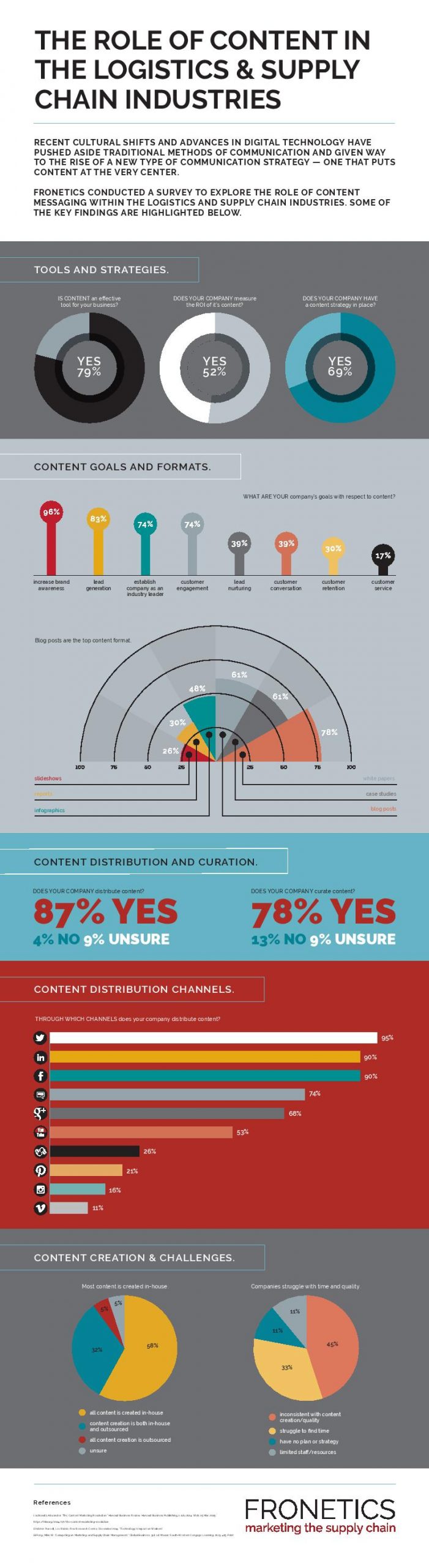
Nearly 80% of logistics and supply chain companies consider content an effective tool for their businesses.
We often use this space to talk to the logistics and supply chain industries about content marketing. Some companies are surprised to learn that this modern marketing method can be so effective for their business. The truth is, content is one of the most useful tools for not only building brand awareness, but also generating leads and earning new customers.
I can tell you this until I’m blue in the face. But, really, what’s most convincing is seeing how other businesses in the industry approach content and how it’s paying off for them.
So we at Fronetics polled supply chain and logistics marketers to determine how their companies are using content. We wanted to find out whether it’s working, as well as their challenges; how they approach outsourcing, distribution, and curation; and more. The below infographic illustrates a few of the key findings from our survey.
(Made with Canva)
To get a complete picture of the role of content in the logistics and supply chain industries, download our report:

Related posts:

by Fronetics | Feb 15, 2017 | Blog, Content Marketing, Marketing, Strategy
Ask yourself these six questions to see if you could be attracting more leads by writing better content.
All too often, marketers fall into the trap of sacrificing quality for quantity in their content writing efforts. It’s an easy mistake to make — the pressure to produce a constant stream of content can naturally lead to a drop in quality. But if you’re not writing high-quality, substantive content, you’re wasting time and energy.
If you’re wondering whether your content might not measure up, ask yourself these six questions.
Do you need better content?
1) Is my content search-engine optimized?
Since over three-quarters of today’s buyers use Google to research products, a key to making sure your content is showing up in search results is search engine optimization (SEO). This means writing copy that will be prioritized by Google in web queries related to your business or products. For ideas on SEO optimization, check out these 3 Quick SEO Tips to Improve Your Blog Right Now.
2) Am I using the right channels to reach my target audience?
In order to answer this question, you first need to have a clearly defined idea of your target audience. Once you know who you’re trying to reach, evaluate where they’re active. Analytic programs like Google Analytics and sites like Tweriod can provide valuable insights on your followers’ social media habits.
3) Am I publishing content, or a sales pitch?
Remember that content marketing is about offering valuable, expert information to your audience — it’s not an overt sales pitch. Present your readers with this kind of expertise, rather than a repeated sales pitch, and you attract loyal customers, and associate your brand with quality and value. Anything you post should be geared to meet specific needs of your customer, rather than to bludgeon them with information about your products or services.
4) Am I providing a good quality user experience?
Pay attention to format, length, accessibility, and voice. Is your business’ website visually appealing and easy to navigate? People will read your content only if it’s visually accessible and engaging.
5) Have I paid attention to performance analytics?
Be aware that what worked last year may not work this year — pay attention to performance analytics to monitor what kind of content is successful and what is no longer generating and converting leads.
6) Is my content good?
This might seem like the most obvious question of all, but it’s important to ask it every time you post. Of course, determining what constitutes good and bad content is the key here. Are you producing writing that is original, substantial, and well written? A good tool to get you started is Fronetics’ On Writing Good Content: A Guide for the Logistics and Supply Chain Industries.
Remember, your content is a reflection of your company. When potential buyers come across your blog posts or other content online, that’s how they get to know you. If it’s poorly written with mistakes and blurry images, well — you look pretty sloppy.
Quality, substantive content shows that you are an authority in your field. It will let potential buyers know that you know what you’re talking about, that you run a polished business, and that they can trust you. So while quantity is important when it comes to content, quality should never be compromised.
Related posts:


by Fronetics | Jan 24, 2017 | Blog, Content Marketing, Marketing
Long-form content generates more traffic, leads, and social shares than shorter content.
We’ve all heard the aphorism, “quantity over quality.” But when it comes to content marketing, part of quality may well be quantity.
While it can seem intimidating, the value of high-quality long-form content cannot be overstated. According to a 2012 study, long-form content converted 30% higher than shorter-form, and the same holds true today. Additionally, long-form posts generate more social media shares and have a higher average Google rank.
Here are some ideas for generating longer-form content that engages and informs your readers, and promotes your business in a meaningful way.
3 tips for creating longer-form content
1. Know your audience.
You first and foremost consideration should be your target audience. Take the temperature of your readers by frequently checking your comments sections, social metrics, and Google Analytics. It can also be useful to conduct a survey, which serves the dual purpose of directly engaging and communicating with your readers and giving you valuable information.
2. Chose relevant ideas.
Read all the articles that are on the first Google search page for your topic, and make sure your post contains relevant information you find. You should be answering as many of the questions that appear in Google Suggest at the top and bottom of the search page.
3. Write good content.
It seems painfully obvious, but it’s worth keeping quality at the top of your priority list. The idea of longer-form posts is to keep readers engaged and encourage them to peruse as much of your site as possible.
Neil Patel suggests that if you “strive to provide enormous value with every word you write,” your writing becomes more targeted. Keep posts visually accessible and easily digestible with short paragraphs, subheadings, and relevant images. Another key element of good content is research. Posts that include actual examples and case studies perform better than data-free posts.
Creating longer-form content may mean that your business needs to devote more resources to its content marketing efforts. But the benefits are well-documented and far outweigh the cost.
Related posts:

by Fronetics | Jan 16, 2017 | Blog, Content Marketing, Logistics, Marketing, Supply Chain
Keep these four trends in mind when planning out your marketing efforts in 2017.
Marketo recently revealed its predictions for upcoming marketing trends for 2017. It’s a list of technologies, strategies, and tactics that the marketing software automation company believes will be important to focus on over the next year.
We culled through these predictions to highlight what the supply chain industry needs to know. Below are four trends marketers should have on their radars.
4 marketing predictions to watch out for
1. Customer-Centric Marketing
For B2B companies, customer-centric marketing means buyer-centric marketing. Because the cost of switching vendors is increasingly low, and the buyer is faced with endless choices, it’s likely that 2017 will see “an aggressive shift in attention toward increasing customer spend.”
This means increasing your focus on building and cultivating relationships. Marketo suggests that companies balance their marketing spend to “invest in building engagement, brand loyalty, and advocacy with current customers rather than just finding new ones.”
It’s likely that technology will play a big role in this 2017 trend. Your company needs marketing team members who are tech-savvy and who know how to analyze and respond to customers’ digital signals.
Focusing on the customer also means building authentic connections and a move toward “giving as much as you get, if not more.” We’ll see more and more customer advocacy, which means that marketers need to focus on taking relationships beyond the transactional. Marketo recommends “providing them with opportunities to showcase their expertise and be recognized by their peers as leaders and innovators.”
The key takeaway: 2017 is the year of building quality relationships.
2. A New Generation of Marketers
We used to live in a marketing climate where specialization was the key to success — no longer is that the case. Your business needs leaders who are “full-brain marketers,” multi-talented generalists who are comfortable handling challenges from the creative design to demand generation — and beyond.
It’s time to abandon thinking in silos. Marketo recommends that your marketing team be in constant connection with other teams within the company. “B2B marketers can now use technology to ensure their sales team have visibility and participation in programs — versus being isolated from critical activities.”
This kind of structural shift requires openness and humility. Marketers need to be willing to take questions and ask them, and to be open to making changes based on increased intra-business collaboration.
Marketo predicts that 2017 will see the perfect storm hit the marketing world, bringing an intersection between fulfilling customer needs, storytelling, and digital interactions. Your company needs to look at its organization and build deep expertise across these three functions. “Any marketing organization that’s missing one of these three functions is destined for failure,” warns Marketo.
This new generation of marketers means that top-performing B2B companies will be making optimal use of technology and data. You need to be investing in resources and technology to drive data enrichment and data governance activities to set a good foundation for your account-based marketing strategy. This also means working closely with sales to understand their thought process for lead prioritization and acceptance.
Here, the key to success is open communication within your organization.
3. Techniques
Marketo has laid out a new equation for how marketers will incorporate techniques to engage buyers at every stage of the cycle:
Inbound + Broad-based lead generation + Account-based marketing + Paid media personalization + Direct marketing = Successful customer engagement
What does this mean for the supply chain? Your company can use a combination of these strategies to engage prospects. For example, combining account-based marketing (ABM) strategies with broad-based strategies will allow marketers to build long-term customer relationships, while bridging their advertising and marketing technologies to demonstrate ROI.
All this focus on ABM solutions will allow marketers to become more efficient, taking advantage of cutting-edge technologies. Marketo suggests creating a detailed ABM plan for all departments, which includes creative marketing ideas to test, as well as new technologies.
It’s time to harness the technology at your fingertips.
4. Content & Channels
2017 is likely to usher in a return to value over volume, both in content assets and in content distribution channels. It’s time to stop creating content for the sake of creating content and to shift toward “deeply listening to and understanding the customer.” This will allow you to cull some of the content and channels that aren’t benefitting your business.
It’s easier than you might think to put this trend into practice. Marketo suggests starting by “deeply understanding the content you already have, and taking the time to evaluate what resonates and what doesn’t.” Next, you can create a plan to keep your content strategy going forward in a meaningful way.
As far as channels go, user experience, particularly for mobile, is going to be increasingly important. You can prepare for this by adding structured data to your site, and by providing valuable content. It’s important to keep a watch on the changing user behavior and expectations, as it will be the biggest driver of change in SEO.
As algorithms continually change, and chronological timeline updates increasingly being phased out, social media channels will put more focus on individuals over brands — this means an absence in brands showing up in feeds organically. You can rise to this challenge by making real-time engagement a priority.
We’ll also see ad inventory becoming tighter and more expensive across social platforms. This means you’ll need to become more specific about the audiences you target, and make your offers increasingly personalized and relevant. Marketo adds the hopeful prediction that “advertisers will benefit from more ways to track offline conversions and non-immediate revenue.”
As email technology advances, email campaigns will begin to predict the content you want and really need. The end result here is “targeted, personalized communications optimized for each person, based on their online and email behaviors.”
The takeaway for content in 2017 is: quality over quantity.
Related posts:

by Fronetics | Jan 12, 2017 | Blog, Content Marketing, Marketing, Social Media, Strategy
Competitive benchmarking should be part of your data-driven marketing strategy.
In August 2016, Elaine Thompson claimed the mantle of world’s fastest woman, and Michael Phelps became the most decorated Olympian of all time. Thompson and Phelps achieved these incredible feats by continuously pushing themselves to do better. To do this, they not only tracked and measured their personal performance, but they also tracked the performance of their peers and of their competitors. Together, this data gave Thompson and Phelps the knowledge and drive needed to improve their own performance.
When it comes to measuring marketing performance, most marketers look inward, focusing on key performance indictors (KPIs) such as website traffic, open rates, social engagement metrics, and conversion rates. While these inward facing KPIs are important, it is also important to look at what is happening outside your organization and to benchmark your marketing performance against peers and competitors. This will give you the knowledge and drive you need to improve your performance and chance of success. It can help you to identify threats and strategic opportunities.
WHO
When adding competitive benchmarking to your marketing strategy the first step is to determine who to benchmark against. I recommend not just benchmarking against direct competitors, but to also benchmark against industry leaders, and against a company or two that you think is excelling (this company does not need to be in your industry). By taking this more global view, you can gain ideas and intelligence from industry leaders and from the creative and strategic minds of top performers. A word of caution – be strategic and keep the number of companies to a reasonable number.
WHAT
While you should determine the KPIs to track and measure based on your business and marketing goals, here are some to consider:
- Traffic by channel
- Visits by source
- Bounce rate
- Keywords
- PPC activity and spending
- Social engagement
- Social reach
- Posting times
- Top performing content
- Meta description (company positioning)
As with your inward facing KPIs, action is key. Use the data you gather to inform your strategy.
You might also like: