by Elizabeth Hines | Feb 8, 2018 | Blog, Content Marketing, Logistics, Marketing, Social Media, Strategy, Supply Chain
These social media statistics are important to keep in mind when planning out your content marketing strategy.
A strong social media presence is key to successful marketing in 2018. Social media is simply unavoidable these days.
So, you jumped on board and you’re posting and tweeting. You’re creating content. You’re learning about search engine optimization and how to improve your rankings. But you’re still not reaching the audiences you were hoping to attract. What’s going wrong?
When you are posting on social media could be as important as what you’re posting.
Timing is everything, and that statement especially holds true when it comes to posting content to social media. If you are sending out your message and nobody is there to see it, you are that proverbial tree falling in the forest; you did not make a sound. Your post had little to no impact.
So, even if you are putting in the time and effort to craft informative blog posts, tweets with just the right message, or Facebook posts that inspire more than just page likes, you still are not getting the most exposure you can out of social media.
We have done our homework when it comes to the best times to post on social media. And the truth is there is no “one size fits all” answer to when you should post. There are general guidelines that differ for each site. But in general, it’s important to keep your target audience in mind when deciding where and when to post.
Here are some social media statistics that you need to consider when deciding when to post your content.
Social media statistics your business needs to consider when publishing content
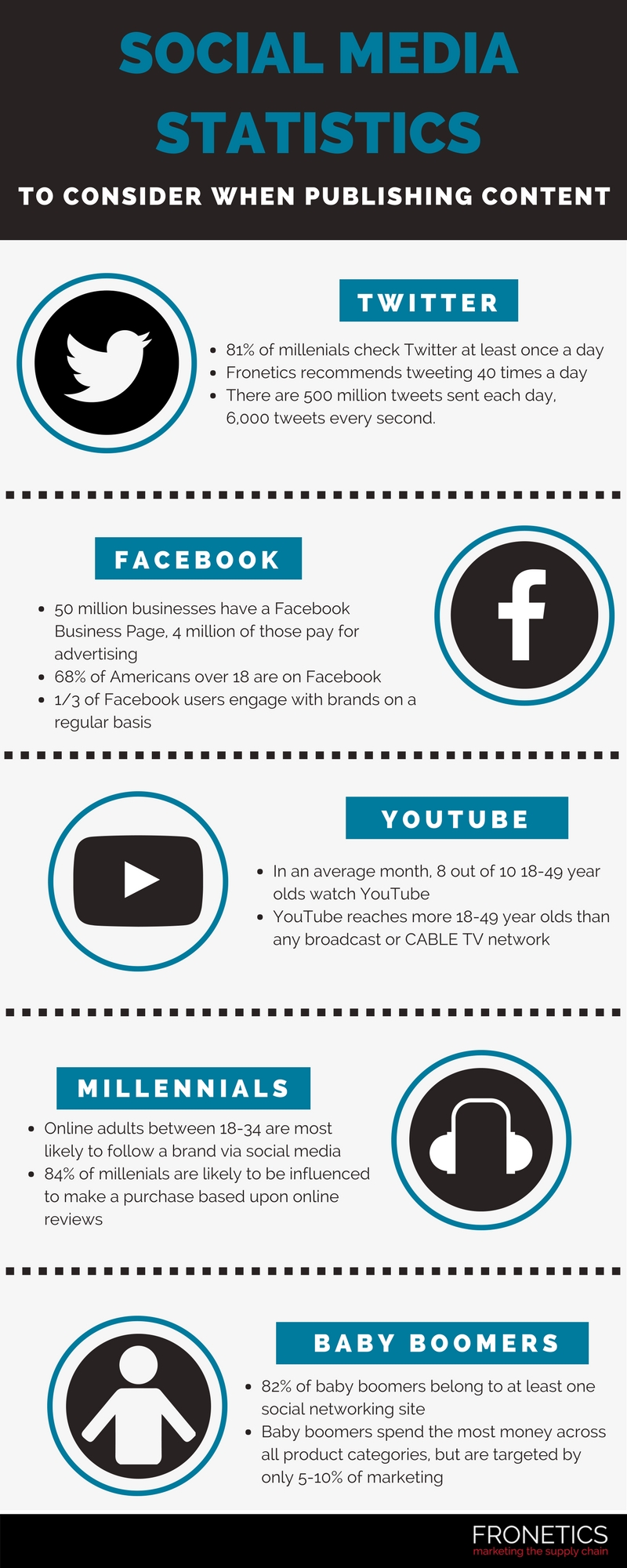
(Made with Canva)
Related posts:

SaveSave
SaveSave

by Elizabeth Hines | Feb 6, 2018 | Blog, Content Marketing, Logistics, Marketing, Strategy, Supply Chain
Here are three tips for creating a content strategy that will help advance your business goals.
If we’re adamant about one thing at Fronetics, it’s creating a documented content strategy. But, as a recent Harvard Business Review article suggests, many strategies fail because they are not actually strategies.
This begs the question: what constitutes a real strategy? According to Freek Vermeulen, associate professor of strategy and entrepreneurship at the London Business School, “A real strategy involves a clear set of choices that define what the firm is going to do and what it’s not going to do.” The keyword here is “clear.”
Here are three strategy-creation tips to help you create a clear content strategy that aligns with and furthers your business goals.
3 content strategy tips
1) Show your work.
Just like in high school math class, arriving at the right answer isn’t enough — you need to communicate the logic for how you got there. As you create or refine your strategy, take a step back and examine the reasoning behind each choice.
Says Sly Bailey of the UK publisher Trinity Mirror, “If there is one thing I have learned about communicating choices, it is that we always focus on what the choices are. I now realize you have to spend at least as much time on explaining the logic behind the choices.”
Understanding the reasoning behind each of your choices allows you and your team to fully believe in your strategy, and ensures you carry it out optimally.
2) Trickle down doesn’t work.
Many implementation efforts fail because executives see strategy creation as a top-down process. On this topic, Stanford Professor Robert Burgelman writes, “Successful firms are characterized by maintaining bottom-up internal experimentation and selection processes while simultaneously maintaining top-driven strategic intent.”
In other words, while you need top-down strategic direction, this will only be effective if you simultaneously empower your employees to create bottom-up initiatives that meet the strategic intent.
3) Flexibility is key.
Another source of failure for implementation efforts is the institutional unwillingness to change habits. “People are often not even aware that they are doing things in a particular way and that there might be different ways to run the same process,” says Vermeulen.
It’s important to identify and effectively work against the bad habits that hamper your strategy’s effectiveness. As Vermeulen describes in his book, Breaking Bad Habits, “There are various practices you can build into your organization to make it work.” This often involves identifying key processes, and asking, “Why are we doing it this way?” If the logic isn’t clear (see above), this process is likely a good candidate for change.
Related posts:


by Elizabeth Hines | Jan 23, 2018 | Blog, Content Marketing, Marketing
Measuring the success of your content is important in evaluating your writing for SEO strategy. Here’s how to do that.
This week, we’re wrapping up our series on writing for SEO. In this series, we’ve explored how search engines are changing, how people are changing the way they search, and how to make use of topic clusters and pillar content. Now, with a better understanding of the changing SEO landscape, it’s time to think about how to measure the success of your content.
As with any marketing effort, having a documented strategy for your content’s search engine performance — and a plan for measuring the success of your strategy — is key. You might be asking yourself, “How do I measure the success of a piece of content?”
Should I measure the success of one post at a time?
When it comes to SEO, the answer to this question can be complicated, largely because it’s not a great idea to evaluate the success of your campaign on a post-by-post basis. It’s too narrow a definition of success to account for the complex network of direct and indirect benefits of effective SEO writing.
Take brand-driven content, for example. Your focus isn’t about generating individual sales, but rather about elevating your brand, raising wider awareness, attracting new talent, or generating backlinks. If you based the success of brand-driven content on the number leads it generated alone, you’d think it was performing terribly. But your post may, in fact, have generated hundreds of backlinks and be getting lots of traffic.
Evaluating by cluster topic
So how do you evaluate success? Rather than looking at your content on a post-by-post basis, consider how all the content under each cluster topic performs as a whole.
According to HubSpot, “Measuring the entire topic cluster against all of your core business metrics will enable you to include residual benefits coming from content that doesn’t align with direct conversion goals.”
As you look at the performance of your topic clusters, consider the following four questions:
- Which topics perform best at driving traffic to your website or other web presence?
- Which topics earn you the most leads?
- Which topics drive the most revenue for your business?
- Which topics earn the most backlinks/coverage?
It’s important to remember that at the end of the day, what you’re working toward — and what will work best for your search visibility — is creating content that people want to see. Writing for SEO is ultimately about creating better content, increasing search engine visibility, and providing the best possible experience for your site visitors.
Related posts:

by Elizabeth Hines | Jan 22, 2018 | Blog, Content Marketing, Marketing
Automation is an excellent tool for marketers, but keep these things in mind when incorporating automation in email marketing.
I recently wrote about a new marketing trend all supply chain marketers should be paying attention to: marketing automation. One area where marketing automation can be particularly helpful is in email marketing.
Marketing automation software can improve your lead-nurturing process and make you more efficient. It can help you provide more personalized experiences for your prospects through email. It can also save you a significant amount of time, as you won’t have to create individual emails each time a particular prospect takes a particular action.
But be wary. Not everything can, or should, be automated or scheduled in advance. As you begin to incorporate automation in email marketing, here are 5 tips to get you started.
5 tips for using automation in email marketing
1) Segment your email list.
Email list segmentation allows you to customize your subscribers’ experiences by only sending emails to certain people based on different criteria. There are millions of ways to segment your list: when someone joined the list, what emails they’ve opened, their demographics, etc. This way, you can provide the most relevant communication to your prospects, keeping them invested — and keeping you out of their spam folder.
2) Timing is everything.
What you might notice is that segments of your list respond more positively at different times. Automation software allows you to take advantage of that, automating email blasts to correspond with the preferences of your subscribers.
3) Text is your friend.
It’s a sad fact that all that time you spend creating beautifully designed images to accompany your email content is wasted. Most of your subscribers will be using email programs that block out additional images. Focus on providing the most relevant, quality content instead.
4) Narrow down your list.
It might seem great to have a large subscriber list. But it’s the number active subscribers, rather than the total number of subscribers, that matters. Refining your email list should, therefore, be an ongoing process. Good news: It’s a task you can automate.
For example, send a “break up” email to members of your list that haven’t opened your emails in a while. If they don’t reply or open it, it’s safe to remove them from the list. It’s also important to make it easy for subscribers to opt out at any time.
5) Keep your finger on the pulse.
This is all about asking your subscribers what they want. It may seem obvious, but this all-important step is often overlooked. As soon as a new subscriber joins your list, they should be receiving an email asking them why they signed up for your email list. If you pay attention to the answer, you’ll now how to segment the new subscriber, which in turns ensures that they get the most individual experience, and cultivates a lasting relationship.
How do you use automation in email marketing?
Related posts:
SaveSave
SaveSave

by Elizabeth Hines | Jan 18, 2018 | Blog, Content Marketing, Marketing
With a high correlation between publishing frequency and web traffic and leads, you need to publish blog content more often to boost lead generation efforts. Here are Fronetics, most of our clients are sales-driven. If a client’s business goals include earning leads,...