by Elizabeth Hines | Feb 4, 2015 | Blog, Data/Analytics, Marketing, Social Media, Strategy

Inbound marketing costs less than outbound marketing. And it works.
The internet has empowered customers. It has provided customers with new methods for finding and researching companies. It has also provided customers with new methods for finding, researching, and buying products.
The internet has changed marketing from a one way street to a two way street.
Customers no longer rely solely on TV/newspaper/magazine ads, billboards, direct mail, email, banner ads, and other traditional outbound marketing channels to learn about new products. These methods are now viewed as too intrusive, especially among younger consumers who regularly tune out the tactics.
Customers want to find YOU (not the other way around)
A study conducted by the Corporate Executive Board’s (CEB) Marketing Leadership Council found that the average customer progresses nearly 60 percent of the way through the purchase decision-making process before engaging with a sales rep. How are they able to do this? By going online. Customers are using websites, blogs, and social media.
A study by Pardot found that 72 percent of B2B buyers begin their research with Google. Other starting points for research: personal networks (15.58%), Yahoo (5.53%), Bing (2.76%), LinkedIn (2.51%) and social networks (2.01%).
What is inbound marketing?
Inbound marketing focuses on consumers finding you.
Inbound marketing meets your customers and prospects where they are, with the information for which they are looking, and at the right moment. Inbound marketing provides value, builds trust and authority, which ultimately result in increased leads and higher conversion rates.
The components of inbound marketing are pretty simple: Create and distribute fresh, relevant, targeted content specifically designed to reach a target audience.
Strategies include:
- Social media marketing
- Blogging and content marketing
- Podcasts
- White papers
- ebooks
- Infographics
- Search engine optimization (SEO)
- Case studies
What is outbound marketing?
In contrast, outbound marketing focuses on paying to broadcast your message to find consumers who will listen to you.
Outbound marketing is a value-driven numbers game. The more banner ads, print ads, and direct mailings you pay for, the more people see your product, and the more sales you’ll make. However, it is costly. Outbound marketing costs 38% more than inbound marketing. The average cost per lead using outbound marketing is $373. The average cost per lead using inbound marketing is $143.
Outbound marketing strategies include:
- Print ads
- TV ads
- Banner ads
- Telemarketing
- Cold calling
- Press releases
- Trade shows
- Email marketing
- Direct mail
Inbound marketing makes sense
Inbound marketing just makes sense. It is a proven methodology and it costs less. Isn’t it time to meet your customers where they are? Get online. Create content. Distribute content. Engage with customers. Optimize your website.
Fronetics Strategic Advisors is a management consulting firm focused on strategy and inbound marketing. When it comes to inbound marketing we take a different approach than other firms. This is because of our business experience and background. We know ROI is important, so our approach is data driven and produces results.
We understand that developing and implementing an inbound marketing strategy can seem daunting. We are here to help. We are happy to take a few minutes and look at your current strategy and give you ideas on how to start, or suggestions on what you can do to make your current strategy more successful. We are also happy to talk with you about what we can do.
We’d love to talk with you about how you can grow your business through inbound marketing.

![Get SMART about your marketing goals [Free Marketing Goals Template]](https://fronetics.com/wp-content/uploads/2024/10/marketing-goals.jpg)
by Elizabeth Hines | Jan 22, 2015 | Blog, Leadership, Marketing
Want to reach your marketing goals? It’s time to get SMART.
Do you know what it is you’d like to see your business achieve this year? It’s likely you do. In fact, most people know generally what they’d like to see happen over the course of a year because they plan. But don’t be fooled, SMART goal setting is far more than just planning.
If you aren’t yet familiar with the SMART Goal concept, it’s essentially a roadmap to success. It makes our goals Specific, Measurable, Attainable, Realistic, and Time-Bound. SMART Goals are a tool that can be applied in many settings. For example, SMART Goals can be used to reduce costs associated with order fulfillment as well as to increase your website’s monthly visits and visitor to lead conversation rate.
Let’s take a look at how one marketing manager, we’ll call him Sam, might apply the SMART goals framework to his marketing efforts.
Specific – Here Sam will describe his goal in detail. He knows he wants to increase website traffic this year, but that’s not enough, so he gets specific. Sam sets a goal of increasing website traffic by 15% by the end of this fiscal year.
Measurable – How will Sam track his progress? In order to keep Sam on track to meet his goal by target date he set, he decides to use the website performance indicators he already tracks monthly.
Attainable – Sam’s goal should be challenging, but not impossible to reach. He reviews his company’s digital media strategy and prior year website traffic reports. After reviewing those, he decides that his current goal to increase sales by $250,000 by the end of this fiscal year is challenging yet achievable.
Realistic – Sam’s company expanded its product line at the beginning of the fiscal year, so it’s likely the company will experience increased marketplace exposure – an ideal situation for his goal of increasing website traffic.
Time-Bound – Sam plans to reach his goal by the last date of this fiscal year. He will track his progress monthly using website performance indicators.
By setting a SMART goal, Sam gives himself a specific focus and builds structure to his general plan of increasing website traffic. Breaking it down into more manageable parts will give him the motivation he needs to reach his goal.
What are your marketing plans for this year? Do you have a SMART goal guiding you? Increase your chances of success by downloading our free Marketing Goals Template.


by Elizabeth Hines | Jan 20, 2015 | Blog, Content Marketing, Marketing, Social Media
Content and social media are integral to business growth
Editor’s Note: This is a guest blog written by Kecia Gray, Vice President, Corporate Marketing & Communications, Transplace. Transplace is a premier provider of transportation management services, intermodal, truck brokerage, and SaaS TMS solutions. Transplace successfully leverages social media and content to expand the company’s brand awareness and thought leadership. The company’s LinkedIn page, Facebook page, and blog were named as “favorites” in a survey conducted by Fronetics.
At Transplace, social media has become an integral part of our marketing and communications strategy and key to expanding our brand awareness and thought leadership in the logistics and transportation space. Our marketing and communication team has had the opportunity to utilize multiple social channels, including:
While we consistently post content to all of these channels, what has been and continues to be important to our social strategy is creating our own original content and utilizing it within a more aggressive approach on Facebook, Twitter and LinkedIn. Sharing content on these channels has allowed our newest blog to achieve fast success in under a year’s time.
Content Is King…
Within any industry, there is always significant opportunity to create original thought leadership content that is informative and insightful. When developing a social media strategy, our foremost goal was to establish a thought leadership blog resource for the market, in addition to providing engaging and personalized content across social channels that was easily sharable. Our main objectives focus on connecting with customers, and creating content that resonates with the members of our industry and provides value to their businesses. By distributing this content across our social channels to foster sharing, conversation and engagement, we’ve continued to gain influence with our targeted audiences.
…And Metrics Are Key
Because of the rapid pace of developing content, it’s important to track and report on levels of engagement to optimize and repurpose information. We created a social plan that included a comprehensive calendar to capture the topics and content items we’d be working on throughout the year. For maximum integration, we purposely aligned new pieces to marketing campaigns and corporate objectives such as events, transportation services and current industry issues. In addition, we established benchmarks and metrics that were important for us to track, such as followers and level of engagement. Analyzing the data allowed us to regularly monitor and evaluate our program, maximize what worked and adjust areas that did not meet expectations.
Incorporating Talent for Quality Thought Leadership
We have also taken advantage of the significant opportunity for Transplace employees at all levels to contribute quality thought-leadership posts across a number of channels. We’ve learned that the best place to utilize this content is on the company’s logisticallyspeakingblog.com. Some of the posts we’re most proud of turned out to be the most popular of 2014, including:
- A motivating guest blog post highlighting our dedication to our customers – from George Abernathy, our president and CCO.
- An insightful commentary on the growth of Transplace in light of a recent acquisition – from Frank McGuigan, president of transportation management at Transplace.
- An informative infographic recap of our signature event, the annual Transplace Shipper Symposium, highlighting some amazing speakers.
To ensure we always stay up-to-date and focused, our team holds quarterly meetings in which we share key highlights, metrics and snapshots of the program quarter by quarter. The time is used to plan for what’s coming up in the future, brainstorm new ideas and make changes as needed. We always make the utmost effort to continually update our program and assess our short and long term goals – an important aspect to any social program!
How is your organization utilizing social media and thought leadership content?

by Elizabeth Hines | Jan 1, 2015 | Blog, Content Marketing, Marketing, Strategy, Talent

93% of B2B marketers use content marketing. However, less than half (42%) of B2B marketers say that they are effective at content marketing. One of the reasons these marketers are ineffective: bad content.
All content is not created equal. There is good content. There is bad content. Good content drives profitable customer action. Bad content does not drive profitable customer action.
You need good content.
What is good content? Here are 3 elements of good content:
1. Good content is original
Good content is content that is unique. It is not content that is copied and pasted. It is not regurgitated content. Not only is original content SEO friendly, original content is customer-friendly. 70% of consumers prefer to get to know a company through original articles.
2. Good content stands out
There are more than 27 million pieces of content shared each day. If you want your content to get lost, create bad content. If you want content that stands out you need content that differs from that of the rest of the pack. You can make content stand out by using winning headlines, graphics, images, infographics, and with great writing.
3. Good content attracts and engages current and prospective customers
Every single piece of content that makes it onto your website and blog needs to be content that is created with your current and prospective customers in mind.
Content that attracts and engages is not a sales pitch. Rather, it is content that communicates valuable information to customers and prospects so that they have the knowledge to make better informed decisions. Moreover, it is content that establishes your business as a reliable source of knowledge – as the thought-leader within the industry.
Good content excites customers and prospects and makes them want to reach out to you.
You get what you pay for
Content creation takes time. However, time is often hard to come by. 69% of content marketers feel a lack of time is their greatest challenge. Moreover, almost 50% of marketers struggle with producing enough content, and producing content that engages.
Faced with constraints of time and volume, quality often takes a hit. In some cases the company itself creates and distributes content of poor quality. In other cases, the company chooses to outsource content creation, but does not do their due diligence with respect to the outsource partner and the quality of content that is created.
Good content is not inexpensive. That being said, good content is worth its weight in gold. This is not something I just say, this is something I know. I gave several low cost content options a try.
I began by conducting a search for companies that offered low-cost content (content that costs less than $20 per blog post). I then narrowed the field down even more by researching which of these companies had the highest rankings and customer satisfaction rates. I then selected two companies and decided to give it a go.
The results were dismal. The content was not good content.
If you want content that is good content and will drive profitable results you need to invest. You need to either invest in someone in-house, or you need to conduct your due diligence and find an outsource partner that can create good content for your company.
Interested in learning more about content? Check out these articles:
Or simply,
by Elizabeth Hines | Dec 31, 2014 | Blog, Content Marketing, Marketing, Strategy
Content marketing is among the hottest topics in marketing and media. However, most companies should stop their content marketing efforts – immediately. The reason these companies should stop is because, despite the hipness of content marketing, they will not realize a positive ROI and will not grow their business through content marketing. In short, many companies are just plain wasting their time and money.
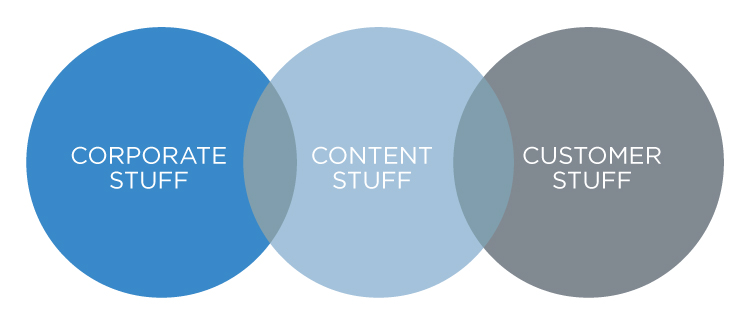
Everybody – companies and customers – has stuff. Joe Pulizzi, Founder of the Content Marketing Institute, discusses the importance of not only recognizing this reality, but also the importance of acting on it.
Pulizzi defines three categories of stuff:
- Corporate stuff;
- Content stuff; and
- Customer stuff.
The majority of companies fall prey to focusing on content stuff within a vacuum. But, as Pulizzi points out: “For content marketing to work, we need to link the corporate stuff with the customer stuff through content.”
What does this mean? This means that in order for content marketing it be effective you need strategy. Strategy is what enables you to link what you know as a brand (corporate stuff) with customers’ needs (customer stuff) through content.
The importance of strategy is underscored by the results of a 2014 study. The study found that 93% of B2B marketers use content marketing. 60% of companies who have a documented content strategy in place consider their efforts to be effective as compared to 11% of companies with no documented content strategy in place. Similarly, the study found that companies who put a person in charge of content marketing were more likely to be successful than those who did not (86% vs. 46%).
If your company is employing content marketing and does not have a strategy in place, stop. Create a strategy, put someone in charge, then re-start your efforts. With a strategy in place, content marketing will drive profitable customer action.