
by Fronetics | Jul 17, 2014 | Blog, Leadership, Supply Chain, Talent
Because great talent doesn’t look like Waldo, here is how to spot great great supply chain talent.

Wouldn’t it be nice if great talent looked like Waldo?
If great talent looked like Waldo we could simply look at the pool of candidates and be able to identify them by their telltale red and white striped shirt.
Unfortunately, great talent doesn’t show itself like our friend Waldo. Given this, how can the supply chain industry spot great talent?
Smart companies realize that it is not the skills the candidate possesses today, but rather the candidate’s personality. This may seem counterintuitive, but consider this – skills can be taught, personality cannot.
Here are five traits that great employees share. When making your next hire look for candidates who possess these traits.
Smart – Smart doesn’t necessarily mean a high IQ. Rather it means having good judgment, being quick to comprehend, and having the faculty of reasoning and understanding.
Ambitious – Ambition drives innovation and productivity. An ambitious individual has high expectations for themselves and for their career. Their drive to succeed will positively impact your company.
Honest – Integrity is everything.
Gracious – A person who is able to admit failure, thank others, and able give credit where it is due will prove to be an indispensable member of your team.
Exceptional communication skills – Communication is the basis of success.
In addition to looking for these traits, also consider whether or not the individual is a good match with your company’s culture.
You can’t train personality
In the end, it is important to remember that you can train an individual to perform the tasks needed for the job, but you can’t change (or train) personality. Be flexible when it comes to specific job requirements, but be rigid when it comes to personality traits.
by Fronetics | Jul 16, 2014 | Blog, Manufacturing & Distribution, Marketing, Social Media, Strategy, Supply Chain, Talent, Warehousing & Materials Handling
According to the 2013 CareerBuilder Candidate Behavior Study, job seekers looking for a position with the manufacturing, transportation, and warehousing industries are using the internet and social media not only to look for jobs, but also to research companies within these industries.
Candidates use the internet and social media throughout their job search
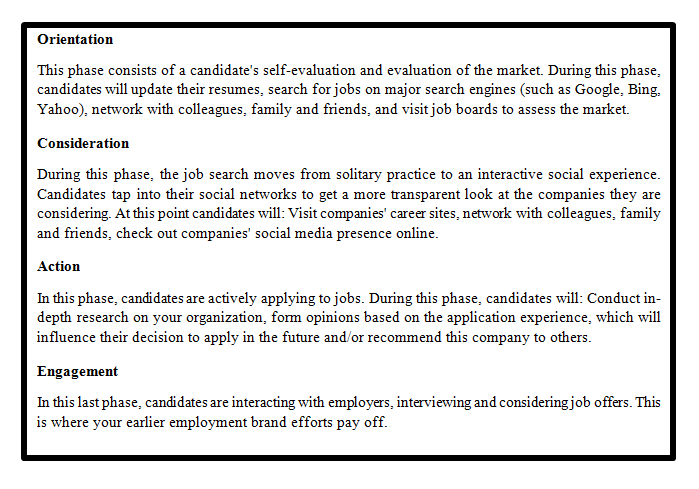
The CareerBuilder study looked at the behavior of candidates throughout the four phases of their job search (orientation, consideration, action, and engagement) and found that the internet and social media were used throughout each of the phases. (See Figure 1 for a definition of each of the four phases.)
Figure 1: The four phases of the the job search
Source: 2013 CareerBuilder Candidate Behavior Study
Job seekers in the orientation and consideration phases have not yet applied for a job at your company. Instead they are assessing the market, learning about an industry, and learning about companies within the industry. These stages are very much knowledge seeking phases for the candidate. Companies who are positioned right can attract great talent during these phases. However, companies who do not have a strong online presence and who do not participate in social media will not catch the eye of job seekers. Think of it as speed dating – you only have a short period of time to make an impression. According to the Neilson Norman Group you have 10 to 20 seconds to make that great impression. If you don’t make a great impression during those few seconds the user will navigate away from your website. Therefore you need to make sure that your website is visually engaging, easy to navigate, and contains quality and informative content.
When a candidate reaches the action stage they not only apply to jobs, they also conduct more in-depth research about a company, and form opinions based on the application experience. Candidates are not afraid to share their experience with the application process. Fifty percent of candidates share bad experiences with others and 64 percent share positive experiences.
In the engagement stage candidates interact with employers, interview for positions, and consider offers. Ninety-one percent of candidates believe employment brand plays a role in their decision whether or not to apply – therefore it is at this stage where your company’s online presence and participation in social media pays off.
How do candidates looking for a position within the manufacturing, transportation, and warehousing industries approach their job search? Let’s look.
Manufacturing industry
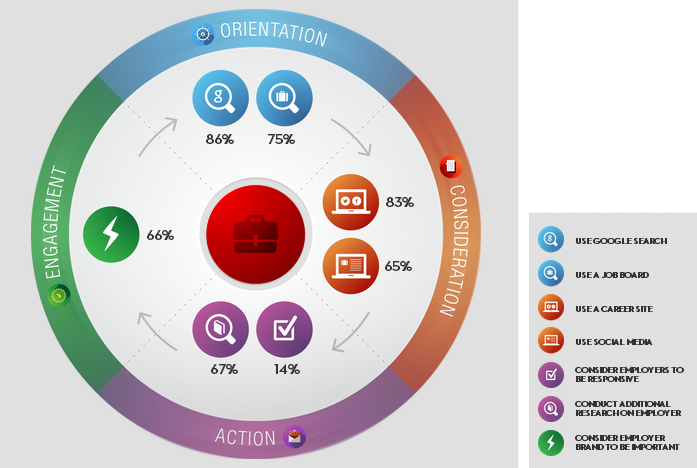
As shown in Figure 2, within the orientation stage, 85 percent of candidates looking for a job within the manufacturing industry turned to Google and 75 used a job board. In the consideration stage 83 percent used a company’s career site and 65 percent used social media to learn more about the company.
In the action stage 67 percent of candidates reported that they conducted additional research on an employer. In this stage only 14 percent of candidates reported employers in the manufacturing industry to be responsive.
Finally, looking at the final stage of the candidate’s journey, 67 percent reported that they felt the employer brand to be important.
Figure 2: The four phases of the job search; manufacturing industry
Source: 2013 CareerBuilder Candidate Behavior Study
Transportation and warehousing industries
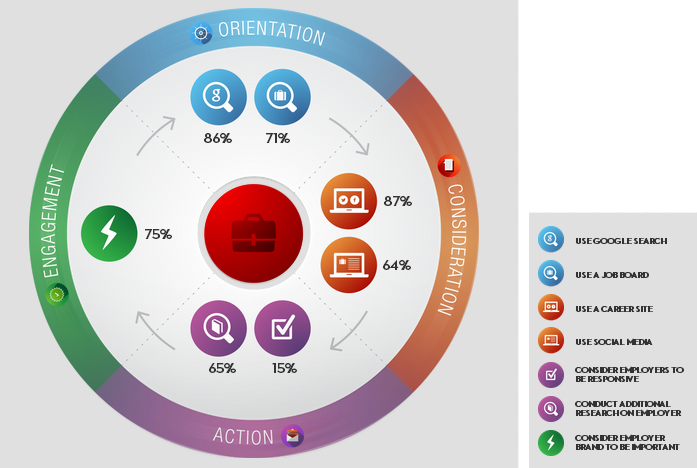
Figure 3 shows that within the orientation stage 86 percent of candidates looking for a job within the transportation and warehousing industries turned to Google and 71 percent used a job board. In the consideration stage 87 percent used a company’s career site and 64 percent used social media to learn more about the company.
In the action stage 65 percent of candidates reported that they conducted additional research on an employer. In this stage only 15 percent of candidates reported employers to be responsive.
In the engagement phase, 75 percent of candidates reported that they felt the employer brand to be important.
Figure 3: The four phases of the job search; manufacturing industry
Source: 2013 CareerBuilder Candidate Behavior Study
In the end
Candidates looking for jobs within the manufacturing, transportation, and warehousing industries are using the internet and social media. They are researching these industries and researching companies within these industries. They are forming opinions, acting on these opinions, and sharing their opinions with others.
If the manufacturing, transportation, and warehousing industries want to attract great talent and retain their interest throughout a candidate’s job search they need to invest in their online presence and become active in social media.

by Fronetics | Jul 15, 2014 | Blog, Marketing, Social Media, Strategy, Supply Chain, Talent
If the supply chain industry is going to attract new and qualified talent, it needs a face lift. The industry needs to be proactive. It needs to communicate what it is, what is currently happening within the industry, and what is in store for the future.
Who is responsible for making change possible? You.
Job seekers turn to the Internet for information. Job seekers not only use the internet to search for job openings, they also use the Internet to research industries, companies, and key players. The information job seekers gather by looking at websites, blog posts, articles, and social media shape their opinion and knowledge. According to the 2013 CareerBuilder Candidate Behavior Study 63 percent of job seekers turn to social media to learn about the employment brand of a company. Specifically, job seekers look to social media to learn about the culture of a company, to learn if the company is a thought leader, and to determine the authenticity of the employment brand.

Job seekers are likely seeing sensational headlines like this recent one from Forbes: Wanted: 1.4 million new supply chain workers by 2018. But what do they find when they move forward with their search for information on the supply chain industry and on your company?
The reality is that the supply chain industry has been slow to participate in social media and has been remiss when it comes to blogging. Even more basic, many companies within the supply chain industry do not recognize the value of their website and have created sites which provide little to no helpful information, are difficult to navigate, and are not up to date.
According to the CareerBuilder Study, 91 percent of candidates believe employment brand plays a role in their decision whether or not to apply.
If your company is going to attract great supply chain talent you need to step up to the plate. Make changes to your website, create and curate great content, and get active on social media.
Great talent is on the Internet. If you want to attract great talent you need to be there too.

by Fronetics | Jul 10, 2014 | Blog, Marketing, Social Media, Strategy, Supply Chain
Kale is the hippest and trendiest of vegetables.
The dark leafy vegetable has received Bon Appetit’s dish of the year award, it was served at the White House Thanksgiving, and it has received ringing endorsements by celebrities and celebrity chefs. Kale also has its own T-shirt, lawsuit, and day. Did I mention the book? 50 Shades of Kale is an Amazon bestseller.
The appearance of kale on restaurant menus has increased by 400 percent since 2008. A recent Guardian article reported that sales of kale at Marks & Spencer are already up 32 percent on the same period last year and that it expects this rise to continue in the longer term. Similarly, at Waitrose, sales of kale are up 20 percent year on year.
How is it that kale is cool? Much of it has to do with re-branding – communicating a new image for the vegetable and communicating new (and more flavorful) uses.
The supply chain is suffering from an image problem. If we are going to attract new talent we need to make an effort to make the supply chain hip. The supply chain should look to kale for inspiration. If a leafy green vegetable can realize such a rapid ascent to popularity, so too can the supply chain industry.

by Fronetics | Jul 7, 2014 | Blog, Strategy, Supply Chain, Talent

According to Supply Chain Insights 60 percent of companies within the supply chain industry have job openings and 51 percent of companies are seeing an increase in turnover of supply chain leaders. This is now. Looking ahead, the Bureau of Labor and Statistics predicts that the number of logistics jobs are expected to grow by 22 percent by 2022 – nearly double the rate of other professions.
The shortage of supply chain talent is generally attributed to a skills gap. Specifically, that graduates with undergraduate and graduate degrees in supply chain management are not adequately prepared for supply chain jobs, and that professionals within the supply chain do not have the skill set necessary to take on management roles.
Thought leaders including Lora Cecere and David Widdifield have offered viable strategies to address the skills gap. That being said, focusing on education and training, employee retention and growth, and rethinking the talent pool itself does not address the bigger issue – the supply chain industry just isn’t perceived as sexy.
Bob Trebilcock captures this sentiment perfectly in a recent piece in the Supply Chain Management Review:
Admit it. You go to a party and someone asks you what you do for a living. You want to say: Hey, I’m the bass player for Metallica or I’m a transplant surgeon or I’m a skydiving instructor. Something with a Wow factor. Instead, a little sheepishly, with averted eyes, you say: Oh, I work in the supply chain.
Here’s the thing – the supply chain industry is perceived by those outside the industry as having no “wow” factor whatsoever. If the supply chain industry is going to attract new and qualified talent, it needs a face lift. It is time for the supply chain industry to rebrand itself.
If the supply chain industry wants to fill open positions with great talent it needs to change its image. Companies within the industry can start by redesigning their website and by becoming active in social media. Companies can also rethink their recruiting materials and talking points.
What is it that makes (or could make) the supply chain sexy? What can the supply chain industry offer great talent? How can the supply chain better showcase the supply chain of today?
If the supply chain industry can successfully rebrand itself, great talent will not dismiss the supply chain industry, instead it will come pounding at the door.