by Fronetics | Mar 31, 2015 | Blog, Content Marketing, Logistics, Marketing, Strategy, Supply Chain
Chief among the determinants of success and failure of companies around the world is the ability to effectively communicate ideas and information. Both internal and external communication play critical roles in advancing business objectives. To be sure, connecting with audiences to convey messaging is a central component of building a solid business strategy. Recent cultural shifts and advances in digital technology have pushed aside traditional methods of communication and given way to the rise of a new type of communication strategy– one that puts content at the very center.
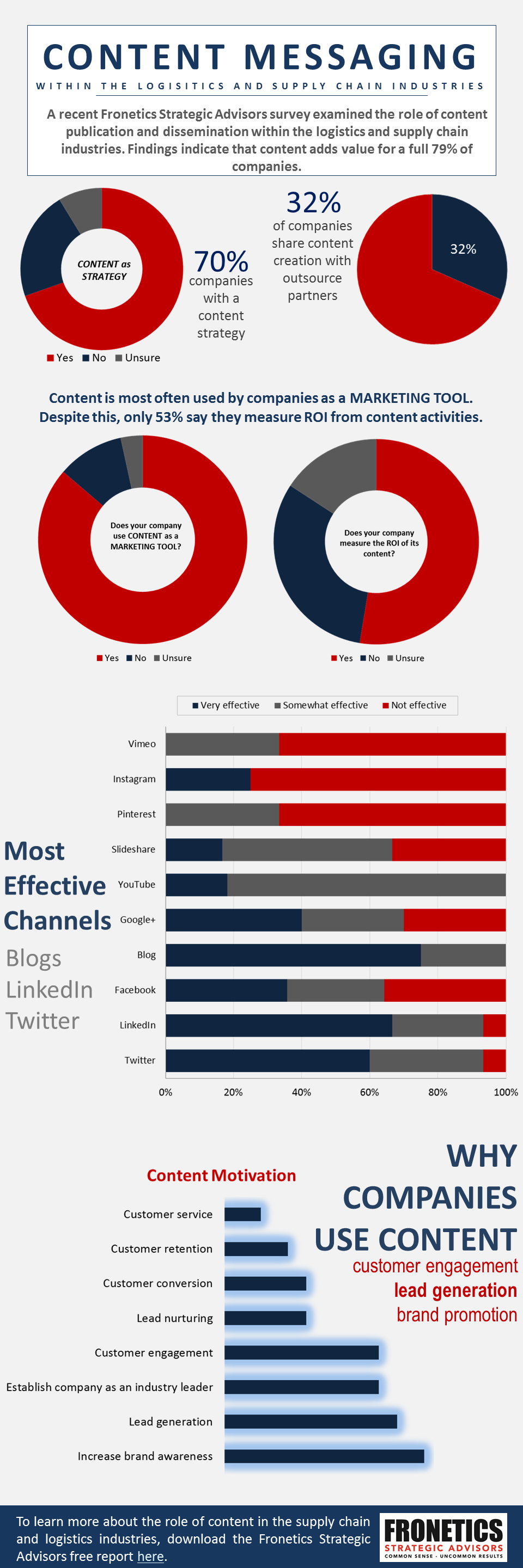
Fronetics Strategic Advisors conducted a survey to better understand the role and use of content within the logistics and supply chain industries.
The survey found that companies within the logistics and supply chain industries are using content as a marketing tool and are realizing benefits.
Survey respondents were asked to identify the goals of their company’s content strategy. The top three goals identified were:
- Increasing brand awareness
- Lead generation
- Establishing the company as an industry leader.
To learn more, check out our infographic, or download the report.

by Fronetics | Mar 30, 2015 | Blog, Content Marketing, Logistics, Marketing, Supply Chain
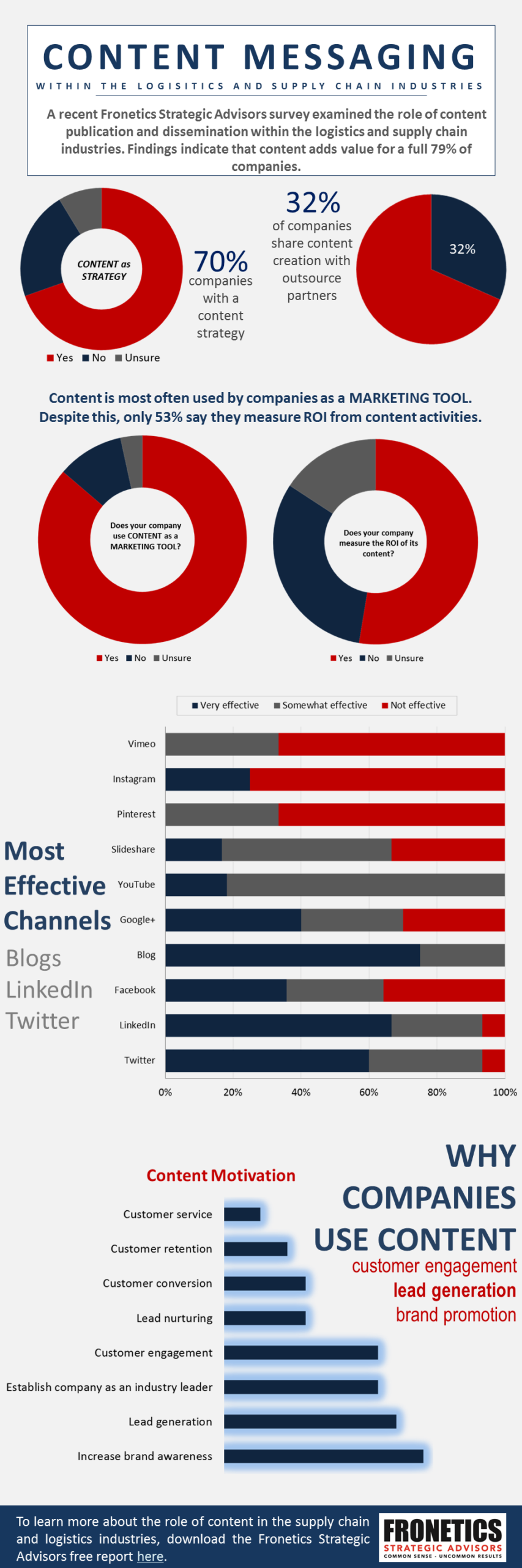
A survey conducted by Fronetics Strategic Advisors on the use of content within the logistics and supply chain industries found that content is being used by companies as an effective marketing tool.
86% of survey respondents reported that their company uses content as a marketing tool. 79% reported that content is an effective marketing tool for their company.
Central to effectiveness is strategy. 70% of survey respondents reported that their company has a strategy in place.
For the majority of companies (58%) the strategy and execution are handled in-house. However, not all companies handle everything internally. 32% of respondents reported that their company outsources some of their content creation, while 5% reported that their company outsources all content creation.
Blog content, case studies, and white papers are the most common types of content created. 78% of respondents reported that their company creates blog content. Other types of content created include:
- Case studies: 61%
- White papers: 61%
- Infographics: 48%
- Reports: 30%
- Slideshows: 26%
To learn more about content and content use within the logistics and supply chain industries, please download the report.


by Fronetics | Mar 26, 2015 | Blog, Marketing, Social Media, Supply Chain
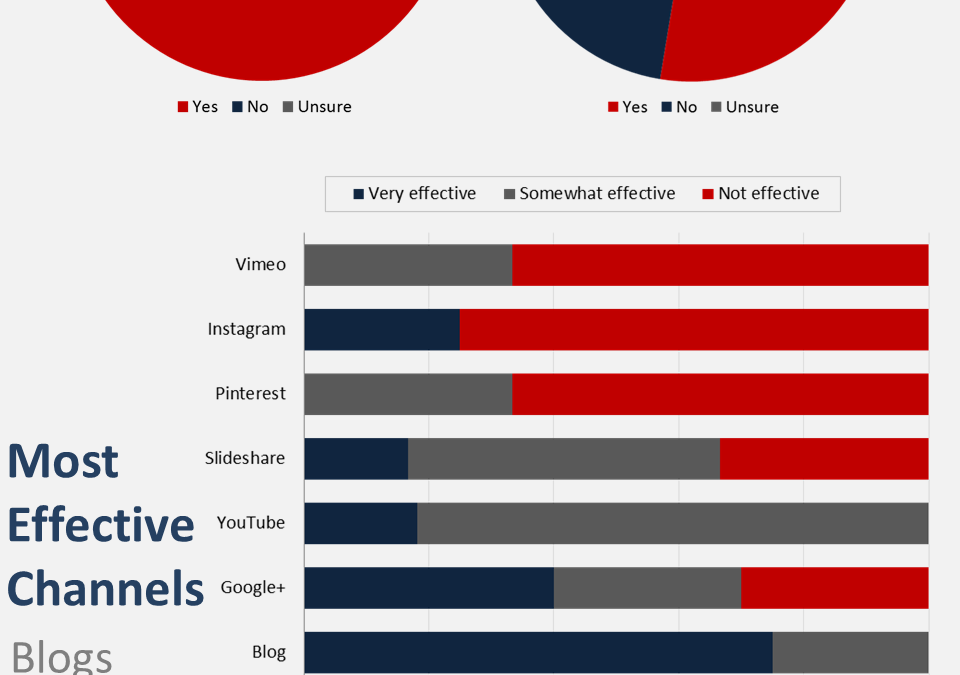
A survey on content use within the logistics and supply chain industries found that company blogs, Twitter, and LinkedIn are seen as the most effective content distribution channels.
75% of survey respondents reported that their company blog is a “very effective” channel for content distribution. 67% reported LinkedIn to be “very effective.”
Respondents reported that Vimeo, Instagram, and Pinterest were the least effective channels for content distribution.
To learn more, download the report.

by Fronetics | Mar 25, 2015 | Blog, Content Marketing, Logistics, Marketing, Supply Chain
B2B companies are creating more content than ever before. This is true too for companies within the logistics and supply chain industries.
Fronetics Strategic Advisors conducted a survey focused on the use of content within the logistics and supply chain industries. The survey found that companies within the logistics and supply chain industries are using content as a marketing tool and are realizing results. 79% of survey respondents reported that content is an effective marketing tool.
Survey respondents reported that their company uses content to:
- Strengthen overall brand awareness (96%)
- Generate leads (83%)
- Establish the company as an industry leader (74%).
To learn more about the role of content with the logistics and supply chain industries, download the report.

by Fronetics | Mar 24, 2015 | Blog, Strategy, Supply Chain

The Blumberg Advisory Group’s 2014 ITAD Trends Report shows that data security is the number one reason why companies implement an IT asset disposition (ITAD) strategy. That companies are concerned about data security is no surprise. Ongoing media reports have not only focused on data breaches, but have also highlighted examples of sensitive data being found on retired assets. The costs associated with data breaches and with the improper disposal of IT assets are great. They include financial implications such as penalties as well as the loss of customer loyalty and reputation. To mitigate risk, asset recovery management is critical to companies operating in today’s global supply chain.
Data security is viewed as an important piece of asset recovery management
Ninety-nine percent of companies surveyed by the Blumberg Advisory Group reported that “concern about data security” is either “very important” or “extremely important” with respect to motivating the creation of their current end-of-life IT disposition strategy. Other important factors include: commitment to “Green” businesses and IT practices, mitigating legal and financial risks, and redeploying assets to reduce costs (Table 1).
Concerns about data security have resulted in companies becoming more aware of the need for ITAD and the need to budget for it. In 2014 87 percent of companies reported having an ITAD budget; 38 percent more than in 2012.
Companies turn to 3rd-party service providers
The majority (63 percent) of companies reported that they use a 3rd-party service provider to manage end-of-life assets. The factors seen as most important in selecting a 3rd-party service provider include: adoption of industry-recognized compliance standards (97 percent); a well-documented and enforced chain of custody (95 percent); and high-quality, thorough client reporting (95 percent).
What to look for in a 3rd-party service provider
ITAD is expensive and it can be risky. It is therefore important to find a 3rd-party service provider who can provide as much safety and security as possible. It is also important to find a provider that takes the time to understand your business and your needs – and develops and manages an asset recovery program that is right for you rather than one that is “out of the box.”
We have put together a list of five must-ask questions. These are questions you should ask providers with whom your company is considering engaging. Before engaging, make sure that you are given answers to these questions and that you feel confident with responses.
-
What is your specialization?
3rd-party service providers are becoming increasingly specialized, particularly when comes to corporate IT take-outs. This specialization is largely being driven by data security and data breach concerns. If your company has highly specialized assets it is essential to determine what specializations, if any, the provider has.
-
Is there uniformity in the process?
Does the provider operate on a single global platform, or will it be necessary to use different platforms for different regions of operation. Uniformity in the process generally increases the ease of operation and ease of use.
-
Who would manage our relationship?
Would the provider assign one global account manager, or will it be necessary to interface with several account managers? Again, this boils down to ease of operation and ease of use.
-
How flexible are your operations?
Disruptions such as recent closure of west coast ports, natural disasters such as Hurricane Sandy, and changing standards and regulations (on a local, regional, and global scale) all impact the supply chain. Given this, it is important that flexibility be a component of asset recovery management.
-
What if something goes wrong?
This question is the most important question to ask. If something goes wrong and if ITAD does not occur as it should, what happens? Does the provider carry indemnification? If so, how much does the provider carry? Will the provider work with you to mitigate risk?
Data security, data breaches, and the improper disposal of assets are issues which global supply chain companies face on a day to day basis. The economic and social implications of the mismanagement of asset recovery are great. It is therefore important that companies operating in today’s global supply chain take the necessary steps to mitigate risk when it comes to asset recovery management.