by Jennifer Hart Yim | Jun 19, 2014 | Blog, Logistics, Manufacturing & Distribution, Strategy, Supply Chain

Entrants to the market need to understand the barriers to entry and problems with management and transparency within the pet food industry supply chain.
This article is part of a series of articles written by MBA students and graduates from the University of New Hampshire Peter T. Paul College of Business and Economics.
The pet food industry is a market that boasts $21.57 billion dollars in sales in the United States (2013). With 95.6 million cats and 83.3 million dogs owned in the United States, it is no wonder that there is such a large market for the food that the self-proclaimed “pet parents” feed them. However, it isn’t all good news for aspiring entrants, as they must first understand the supply chain that dictates this growing industry.
To manufacture, or not to manufacture
When a pet food company chooses to produce a product, they essentially have three options: 1) manufacture it themselves, or choose a co-packer who will either 2) use a private label or 3) manufacture the food to the specifications of the brand.
A contract packer (co-packer), otherwise known as a contract manufacturer, is a company that manufactures and packages foods for their clients. The manufacturer works under a contract with the hiring company to manufacture the pet food as though the hiring company was doing it themselves.
Co-packers can manufacture several different brands and for several companies at once. An example of a co-packer would be C.J. Foods, Inc. with manufacturing plants in Bern, Kansas, and The Pawnee City, Nebraska. According to C.J. Foods Inc., the company produces over 300 varieties of animal foods, including dog, cat, reptile, and exotic bird.
Companies typically outsource to another entity for production due to cost savings, rather than building their own plant. Additionally, they can focus on their own core competence, whether it is marketing, sales, etc. The manufacture’s core competency is production, and they have the experience and knowledge to produce the pet foods already. However, there can be many challenges associated with the management of pet food supply chains and co-packers in particular.
The challenges with co-packers
As the pet food market grows and becomes more complex, the sourcing of ingredients becomes more complicated.
Foreign suppliers source products from numerous small farms, and identities become lost and commingled. Unfortunately, brands are relying on these suppliers to meet food-safety criteria.
Additionally, these brands typically rely on audits of suppliers by private third-party companies that carry no guarantee. An example of this would be Kellogg and Peanut Corporation of America (PCA). Kellogg had PCA audited by AIB international, and PCA passed with a superior rating. However after the recall (explained in detail below), the FDA found leaks and rodent infestations within the plant.
Pet food industry product recalls
There have been two major recalls within the pet food industry in recent years.
One, the largest in history, was the ChemNutra recall in 2007. Two Chinese export firms sold wheat gluten bags tainted with melamine to Las Vegas-based ChemNutra, “the Chinese ingredient specialist importer.” ChemNutra then sold the tainted wheat gluten to pet food makers under false certificates of analysis. As a result, 5,300 pet foods were recalled, and thousands of cats and dogs were injured/killed. Owners of both the Chinese companies and ChemNutra pleaded guilty to various misdemeanors involving the mis-branding of food and conspiracy to commit wire fraud.
The second recall involves a 2009 salmonella outbreak in the Peanut Corporation of America’s plant in Blakely, Georgia. PCA knowingly shipped salmonella-tainted products across the country to many manufacturers, including those in the pet food industry. Along with the shipments, they sent certificates of analysis that indicated the product contained no salmonella, but they had yet to receive the test results (which were positive). This resulted in 3,200 pet food products being recalled, 8 deaths, and 500 illnesses. A 76-count indictment charged four former officials at PCA with numerous infractions relating to salmonella-tainted peanuts and peanut products.
These two examples are the horrific results from a lack of control over the supply chain within the manufacturing of pet foods. The consequences of these recalls, first and foremost, can cause the injury and death of both pets and people. Beyond that, there is implicit lost brand trust, consumer demand decrease, headaches for retailers/wholesalers, and severe cost increases for the company.
Solution: Improving supply chain management
Given the information above, it is essential that companies proactively work to avoid recalls through better management of the supply chain.
Co-packers become problematic when an ingredient or plant is infected because that trickles down to the many different brands and companies for whom they manufacture. That is not to say that pet food companies should never use a co-packer, especially because the cost-saving benefits can be so great. Pet food companies, however, should do their research prior to choosing a co-packer.
If you are using a private label, know where the co-packer is sourcing its ingredients. If you are not using a private label, you need to ensure you know the suppliers with whom the co-packer is working. The same rule applies if your pet food company has its own manufacturing plant, as well.
Secondly, pet food manufacturers can supplement third-party audits of co-packers’ plants with their own inspection and testing of ingredients and plant surfaces.
As a consumer purchasing these foods off the shelf, attempt to do your research, too. Although you may not be able to see exactly where products are coming from due to confidentiality of competitive sourcing, you can choose brands that have a commitment to transparency and educating the consumer on where their ingredients are sourced from. An example of this would be Natura Pet Products, which launched its “See Beyond The Bag” campaign. This part of their interactive website allows consumers to click on any product and view where in the world any specific ingredient in the product is being sourced from. Additionally, consumers can educate themselves on how Natura ensures a quality manufacturing process.
In conclusion, pet food manufacturing can be a difficult industry if a company is not well versed in the associated challenges. If a tight reign is held over the supply chain and quality manufacturing follows, the pet food industry is a growing market with a bright outlook for companies vying to do business within it.
Mikayla Cadoret recently completed her MBA at the University of New Hampshire – Paul College of Business and Economics. She is an experienced sales representative and is interested in pursuing a career in marketing or supply chain management. She can be reached at [email protected].
by Jennifer Hart Yim | Jun 12, 2014 | Blog, Data/Analytics, Strategy, Supply Chain
This article is part of a series of articles written by MBA students and graduates from the University of New Hampshire Peter T. Paul College of Business and Economics.
Regularly tracking your relationship with your suppliers and their performance toward your expectations is critical to ensure the success of your business. One mechanism for tracking this is the supplier scorecard. A scorecard is in essence a report card for your supplier. Supplier scorecards when used effectively can help maintain a healthy supply chain and will benefit both parties. If not used effectively supplier scorecards can damage the supplier relationship and hurt both businesses.
Effective scorecards should use meaningful metrics. If it doesn’t align with business goals then it shouldn’t be measured. Easily measured variables of no importance will just cause clutter; they could also cause a supplier to focus their performance in areas that do not matter. If the metrics are not clearly defined and understood by the suppliers then it will be hard for them to adjust their performance in these areas. Another consideration is there may be things that are important to you which your suppliers have no way of measuring or attaining the performance you are asking for.
As with all business to business relationships communication is critical for maintaining and improving supplier performance. To ensure suppliers meet your needs you should communicate to them from the offset how their performance will be measured. You can even tie bonuses and penalties into their performance scores. You should be mindful that your relationship with your supplier should be collaborative; as you grow so should they. You should share the results of your scorecards with your suppliers on a regular basis and shouldn’t wait until a review to raise a concern. Another important aspect of communication is sharing your business objectives and performance data with your suppliers. This can help them to better shape their business to meet your needs as your business fluctuates.
It is important when evaluating suppliers to have a good process in place for tracking important metrics. When possible it is best to use accurate data that is understood by both you and your supplier. If you use fuzzy metrics which are subjective then improvements become difficult to measure and target. Also, tracking metrics throughout the scoring period will help to ensure the data is accurate and your scorecard reflects actual performance.
When dealing with different suppliers it is important to make sure the metrics you are evaluating are relevant to each supplier. As a result it is not recommended to use a one size fits all approach to supplier scorecards. Another thing to keep in mind is that you may be sourcing from the same supplier through multiple locations. It is important to track each of these on its own scorecard to help your supplier learn where they are doing things right and where they are falling short of your expectations.
Where I work we have several strategic supplier partnerships. The way we manage supplier relationships is through quarterly business reviews with each of our partners. In these meetings high level representation from both companies is present. We share with our partners our business results and forecasts in addition to any major company news. After sharing this information we review our scorecard process with the suppliers, show a score card comparison, take a detailed look at each rating, and then provide an overall summary.
Our scoring system looks at aspects of quality, delivery, cost, support, and inventory management. With respect to quality we look at hard numbers like failures out of the box and returns from our customers. We take into account both product quality and process quality. When it comes to delivery we measure on-time delivery, missed shipments, and lead times. Some of our customers have long term fixed cost agreements so this metric isn’t required, for others the cost fluctuates; we measure whether or not their costs are in line with our expectations. Support has several levels including technical support, order support, and special cases. Inventory management tracks how well they are able to maintain some inventory on hand for us.
Our scorecard metrics used to be scored on the basis of a five point scale from far below expectations to far above expectations. After running through several of these scorecards we determine that it was not likely to get exceeds expectations because the only time expectations could be exceeded is if our demand was well above our forecasts. Since this goal wasn’t something attainable by a supplier of their own action we adjusted our scorecard to have only three levels, from below expectations to meets expectations.
The scorecard comparison is unique to the supplier and it shows the ratings for each of the metrics for the current review period as well as four prior quarters. We display this in a color coded matrix so that it is easy to see where each metric is improving, staying the same, or regressing from period to period. For my employer these quarterly business reviews give us frequent touch points with our suppliers. This helps us to identify issues and areas for improvement to strengthen our supplier relationships and our business.
Throughout this article I have hit on several best practices with respect to supplier scorecards. I want to stress that this is just a tool. The fact that you have a scorecard system in place should not prevent you from acting immediately if issues present themselves. After all, this should be a collaborative exercise which will benefit both your company as well as your suppliers. In addition it is important to solicit internal feedback from interested parties. Supplier scorecards should be used to make decisions about whether or not to continue supplier relations or to pursue alternative suppliers.
Mike Cleary is a Software Quality Assurance Engineer at Empirix pursuing his Masters of Science in Management of Technology from the University of New Hampshire. He has over ten years of experience in testing IP and telephony solutions across a variety of platforms. In his current role he is responsible for not only ensuring Quality in the E-XMS solution but other administrative tasks such as lab configuration, VM server, and perforce administration.
by Jennifer Hart Yim | Jun 5, 2014 | Blog, Manufacturing & Distribution, Strategy, Supply Chain
This article is part of a series of articles written by MBA students and graduates from the University of New Hampshire Peter T. Paul College of Business and Economics.
By now we have all heard the story of GM’s faulty ignition switches that are being linked to thirteen deaths and thirty one front-end collisions. The ignition switches in car models: Chevy Cobalt; Chevy HHR; Pontiac G5; Pontiac Solstice; Saturn Ion; and Saturn Sky, lacked the torque specs required by GM engineers. Heavy key chains, bumpy roads, or an accidental knee hit were all reasons reported that could cause the ignition switch to rotate to the off or idle position. Once this happened, the driver would lose control and the air bags would fail to deploy if a front end collision occurred. A total of 2.6 million vehicles were recalled, of that 2.2 million were in the United States. For this type of recall, GM was not requiring vehicles to go back to the manufacturer or be disposed. Rather, a more robust key ignition was distributed to all authorized GM dealerships and customers were told to bring their cars to the local dealership and a new ignition switch would be put in for them.
Despite the massive recall and all the negative publicity that goes along with such an event, GM still posted positive numbers in their quarterly earnings. GM posted an operating income of $0.5 billion for 1Q14, which is included the $1.3 billion recall-related charge. Furthermore, GM controlled approximately 17% of the U.S. market share. After the ignition switch incidents started to gain traction, GM swore to reorganize their global engineering department, and they did. So, if GM’s sales profitability is surviving, their negative press contained, and their market share intact, what exactly went wrong?
Two-thirds of General Motors automotive costs in 2014 are from supplier sourced parts. However, this was not always the situation. Back in 1999, GM underwent an extensive effort to disassemble their vertical integration in hopes of reducing overall costs. At this time, Delphi Automotive was owned by GM, but separated during the same year. For decades, GM was Delphi’s only customer, and even when Delphi executives knew GM was going to make them a public company, they were only able to move 22% of their business to other customers. When GM officially made Delphi a public company, 82.3% of their shares went to GM shareholders. That means that only 17.7% of Delphi was sold to public investors. In order to survive as a company, Delphi had to start making cost reduction decisions. To do this, companies often lay off employees and make cheaper parts, Delphi was no different. Now during this same time period, GM executives were focused on focused on costs reductions and were driven by numbers, hence the selling off of Delphi. It should be noted that if a company sells off their single largest parts supplier, fully aware that the move may cause the supplier to go belly up, there will be some strained relationships. Delphi was now thrown into a position where they must compete with other parts suppliers for GM’s business. An important part of the deal GM made when selling off Delphi was to keep all current supplier contracts. In addition, GM gave Delphi the opportunity to match any competitor’s bid until 2002. The earliest model of a recalled GM car was 2003.
Strained supplier relationships are not ideal for business, but should not affect the quality of a product, such as an ignition switch. Let’s fast forward to 2008. Delphi had declared bankruptcy three years prior and GM was beginning to pull them out of their financial burden. A contract was found between GM and Delphi that was drafted in 2008. The document is a little difficult to follow, but there are a few interesting lines in Section 5.09 Product Liability Claims. It appears that, GM said they would share the blame with Delphi for any claims against them. However, GM would not be held responsible if one of Delphi’s parts, or a part made for Delphi by a third party, fails. The contract continues on to say that GM would pay any legal fees if a claim was made against Delphi, but Delphi must defend GM through a potential lawsuit. This contract was drafted and signed in 2008, during which Delphi was bankrupt, so it appears they had little negotiating power.
This raises concerns specifically about the ignition switch specs. It came out that GM officials knew the ignition switch they purchased from Delphi was not up to their standards. After some more research, an email transaction between Delphi officials in regards to the plunger, the vital part that holds the key slot in place with a spring, and the ignition switch. At the end of the document, the original engineer drawings are attached. From the technical drawings it can be seen that Delphi did in fact outsource the design specs, and possibly the manufacturing, for the plunger design. Another document, that was preceding the email transaction, appears to inform GM that the plunger part was changed and the responsibility of the supplier is “closed”. This could have been a legal move meant to save Delphi if any claims were made related to these parts.
After all of this evidence, where does the blame lie? It would appear that GM used their powers to force Delphi into a contract that held them responsible for any claims against their products. While Delphi did warn GM that the torque requirement for their ignition switch did not meet GM’s requirement, it is unclear whether or not a verbal warning will play into the legal battle. This case is currently ongoing, and it will be interesting to see how it plays out.
Connor Harrison holds a B.S.M.E and MBA from the University of New Hampshire.
by Jennifer Hart Yim | May 28, 2014 | Blog
This article is part of a series of articles written by MBA students and graduates from the University of New Hampshire Peter T. Paul College of Business and Economics.
In an increasingly globalized world the complexity in a firm’s supply chain has been getting bigger as it has spread over the whole globe. The risks of such a large supply chain have increased exponentially as the exposure to unforeseeable events, natural and man-made, have multiplied. Investing time and money in a Business Continuity Plan and hence building a resilient and flexible supply chain can not only become a competitive advantage but it is also critical for a firm’s survival.
Supply Chain Disruptions
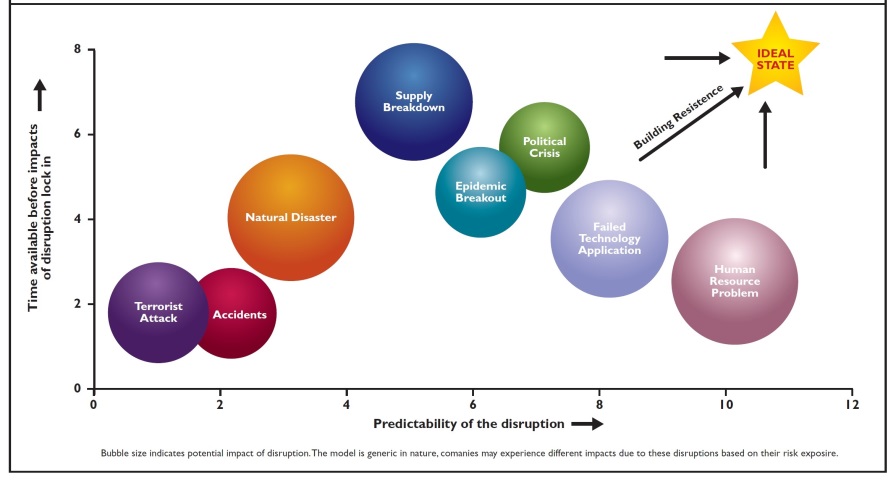
Supply chain disruptions happen for various reasons but always cause and end in an imbalance of the supply and demand of products. The magnitude of such events can go from insignificant to the size where the existence of the business is threatened. As shown in Graph 1 the disruption can have immediate impact, such as a power outage or fire in a factory, or take more time to set in. A union labor strike or the outbreak of an epidemic virus in a certain region could describe more predictable examples.
Graph 1: Supply chain disruptions categorized by predictability and time available after impact.
Where disruptions in tier one suppliers always have a direct impact of a firm’s supply chain, tier two and three disruptions can be buffered and show their effects only when the disruption gets to a certain size and reach. As an organization can never be fully in control of its business environment and supply chain it is safe to say that every business will sooner or later face some sort of disruption. Disruption can be costly. In 2013 15% of the disruption cost more than one million US dollars. Knowing this, businesses will benefit from developing a Business Continuity Plan.
Business Continuity Plan
A Business Continuity Plan is a road map for continuing operations after and/or during a disruption. The main components of a Business Continuity plan are:
- Business impact analysis
- Design of solution/remedy
- Implementation
- Testing
- Maintenance/feedback
Business Impact Analysis
The analysis of the severity of the impact to the business will help prioritize further action and the design of the solution. The analysis differentiates the critical and non-critical events and lists them accordingly. The criticality can be based on cost, ability to continue the operation, brand reputation and also laws. A threat and risk analysis combined with various impact scenarios will be the basis for the design of a solution.
Design of a solution/remedy
The solution design part of the Business Continuity Plan comes up with the most cost-effective recovery solution. Additionally, it identifies authorities for decision making during disruptions (crisis management command structure) as well as which contracts, documents and contact lists have to be available as a hard copy outside the facility. On the operational level this includes but is not limited to:
- Backup power
- Logistic routes
- Back up suppliers and lead times
- Warehouse/distribution center locations
- IT back ups
- Talent and skill succession planning
Implementation
The implementation phase involves strategic decisions, such as policy changes and training of the company’s own staff, as well as the communication of the Business Continuity Plan to suppliers and customers. The acquisition of materials and systems are part of the implementation. IT infrastructure can be moved to cloud computing for data safety and modern systems are extended to allow visibility into the supply chain. This can go as far as the second or third tier.
Testing
Testing will show if the elaborated solutions will satisfy the requirement. Testing can be as simple as an evacuation drill or as complex as a mock recall.
Maintenance/feedback
The first step of maintaining the Business Continuity Plan is to constantly monitor the situation around the identified risks and threats in the Business Impact analysis. This will also help foresee possible disruptions and might allow acting ahead of time to prevent a bigger impact. The Business Continuity Plan must evolve with the threats and the company development/growth. This requires constant updating and testing as well communicating to the staff, important clients and suppliers. More significant changes might even require updating of organization structures.
Feedback after a disruption event can be as vital to a Business Continuity Plan as its design. The reevaluation of the supply chain will allow assessing the effectiveness of the plan, the resilience of the system as well as the validity of the sourcing strategy. Collecting all these findings in a report will allow making sustainable changes. Such reports can also be helpful when negotiating terms and conditions with suppliers and/or insurance providers.
Summary
The design and implementation of a Business Continuity Plan is a big undertaking for a firm. The likelihood of disruptions in the supply chain and in other business processes is increasing with globalization. It is recommended that the firms start somewhere and attack the low hanging fruit. With a Business Impact Analysis the risks to the business can be categorized and prioritized. This knowledge can be used for the development and growth of the company as preventive measures can be built in new structures. The importance of monitoring the threats and learning from disruptions can become a competitive advantage and secure the existence of the business. While Business Continuity Plans can be structured simple and still cover the five components there is also professional education and training as well as certifications to support the continued success of the business.
Dario Cavegn hold a Master’s of Science degree from ETH Zurich in Switzerland. Currently he is working as a Manufacturing Manager for Lindt & Sprungli (USA) Inc., and is an MBA candidate at the Peter T. Paul College of Business and Economics. He can be reached via email at [email protected].
by Jennifer Hart Yim | May 8, 2014 | Blog, Marketing, Social Media, Strategy, Supply Chain
This is the third in a series of blog posts written by Adam Robinson, Director of Marketing at Cerasis. Founded in 1997, Cerasis is a top freight logistics company and truckload freight broker.
Now that you know about how to create a strategy, you have to execute it. This means content creation, content curation, and using the best tools possible to be effective.
#1: Content Planning
Categorize Target Audience By
- Industry: For example, we knew that within our target audiences, we had the following industry categories: Manufacturing, Distribution, Supply Chain, Logistics, Transportation
- Job Function: Next you then need to understand who are the buyers and what are their personas? Once you do this, you can weave in messaging into your content that speaks to all of them. At Cerasis, we knew our job titles were: C-suite, Managers, Employees
Create Content to speak to categories
Now that you have the categories, it’s time to create and plan for content. When you are coming up with topics, make sure you write the categories down and start creating headlines and doing research in those categories. You will notice on the Cerasis blog that there are broad categories like you see from the ones stated above, but over time we started shifting towards creating sub categories of those broad categories (e.g. Reshoring under manufacturing, or inbound logistics under logistics).
Ways to Generating Content Ideas
- Internal Interviews and Brainstorms
- Use an RSS aggregator such as feed.ly so you can curate articles and start to better understand the marketplace
- Be active in Social and Notice Most Shared
Using a Calendar
Whether you are doing one post (or more) per day or just one per week, a calendar is vital to long term success. If you don’t know what you are writing about each day, it is really easy for you to NOT write it and NOT achieve your goals. Content marketing is an ongoing project plan, and you can use tools such as Asana to have multiple people share the same workspace and work through the content.
Look out for Guest Bloggers
Another great idea for scaling content marketing and not burning out is to reach out to influential bloggers to guest blog for you. Or these can be other companies who are noncompetitive but share a similar target audience. We have had several guest bloggers that line up nicely and are relevant to our content categories. However, don’t take anyone that doesn’t add value to your readers. Think like a publisher and protect yourself from those spammy guest bloggers. You also must be proactive in networking and reaching out in social platforms as you establish relationships online such as on LinkedIn and Twitter.
#2: Content Creation
This is really where most companies get stuck. At Cerasis we leverage our employees and interviews to help get content written. You can also use great ghost writing services if you would like, but I would urge you that you write in house, as you know your authentic voice. The key is to stick to a regular schedule. Sporadic posts are going to find it difficult to build an audience. Think about your TV guide and the schedule of shows. You don’t always have to watch it the day it airs, but at least you know that it will be there.
#3: Content Distribution
If a tree falls in the woods, and no one is there to hear it, does it really make a sound? This old adage is very true when it comes to content and social media marketing. If you are not posting your content in any of the social media channels or online communities, then you are not going to be effective either. Even with search engines out there crawling your new content, search engines are now favoring social signals from sites like LinkedIn, Twitter, and Google+.
We recommend the following tools to use to distribute your content:
- Oktopost: This is a fantastic platform for distributing content as well as analyzing your performance. Their strong suite is the ability to post into multiple LinkedIn groups and mimic the categorization of your content through tagging of your groups. You can also post to many platforms such as Facebook, Twitter, LinkedIn pages, profiles, and groups, Google+ and more. Our favorite feature is the Autoposter. This feature allows you to load up a cache of content and set a schedule in the future so you don’t have to use resources to post every day. In one sessions you could set up a 30 day posting schedule right in the platform and view on a calendar!
- Buffer: This platform is great for content curation. You can load in your social profiles and then set pre-determined times on any day. We really love buffer for mostly Twitter, since Twitter is much like a newspaper where you go to find all the latest news and articles on topics of interest to you. Each morning we load up our RSS aggregator, feed.ly, and buffer all the best articles for our audience.
- Feed.ly: We love feed.ly as it allows to mimic (again) our content categorization but for other sources! It’s also a great way to find other blogs and influencers in your space you can network with and potentially guest blog for. All you have to do is search for content by keyword, add them in the respective category and bam, in one platform you have your own customized newspaper from which you can curate content. It’s got the buffer app loaded in so you can easily add articles to your buffer. This is also a great way to find new ideas for content and keep you up to date on your industry!
- Tweetdeck: This platform is owned and maintained by Twitter, but allows you to not only post to and monitor your account, but also allows you to monitor industry hashtags, such as #manufacturing or #logistics so you can start to follow and interact with those in your target audience. It’s a great tool and we recommend using it!