At Fronetics we typically post content to Twitter an average of 40 times per day. That’s an average of 40 times per day for Fronetics, and an average of 40 times per day for each of our clients. That’s a lot of time on Twitter. Given this, the numbers given by Socialbakers and Buffer caught my attention. Could we reduce the frequency to which we post to Twitter and keep (or even increase) engagement and ROI? We decided to do the experiment.
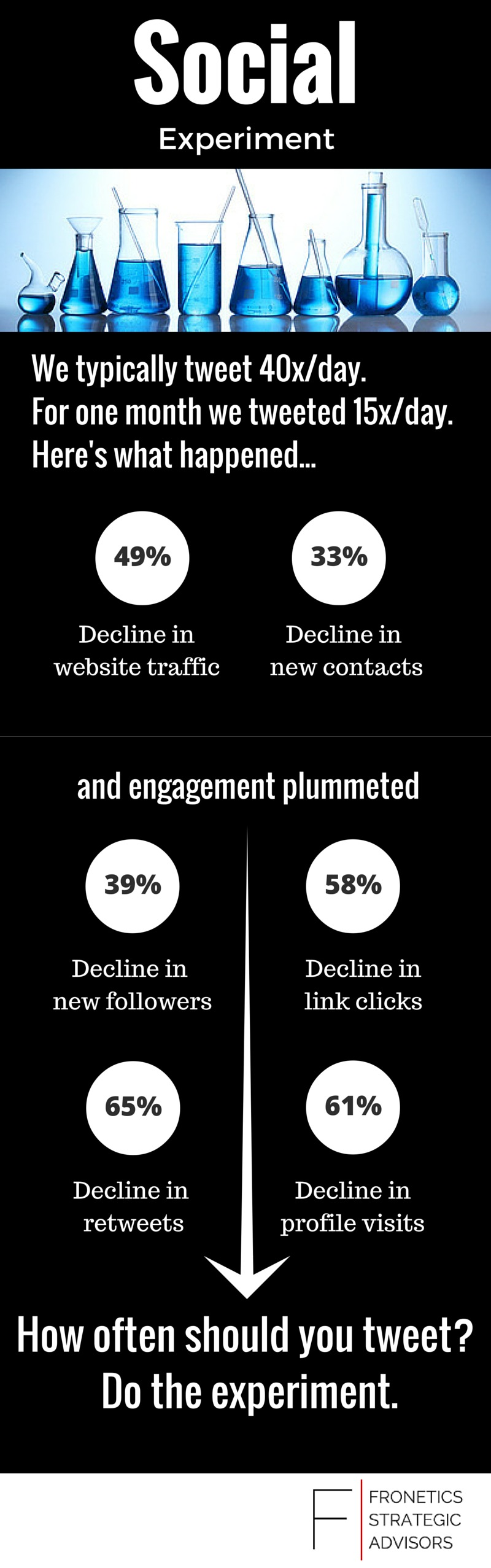
As shown in our social experiment infographic, when we reduced the number of times we post to Twitter from 40 times per day to 15 times per day, our engagement and ROI plummeted.
Not only did we realize close to a 50% decline in traffic to the website, we also realized a 33% decline in new contacts. That’s a 33% decline in our lead pipeline.
We also realized a decline in link clicks (58%), profile visits (61%), retweets (65%), and new followers (39%). In short, our engagement numbers took a dive – off a cliff.
Although the numbers were abysmal, the experiment was a good one. It showed that, for Fronetics, posting to Twitter at a frequency of around 40 times per day is right for our company.
Does that mean the frequency is right for each of our clients? No. Does it mean that the frequency is right for your business? No. What it means is that there is no magic number when it comes to the ideal frequency for posting to Twitter.
Your company, or your marketing partner, should conduct due diligence and determine what the right frequency is for your business. Yes, you may realize a significant decline in engagement in ROI during your experiment. On the other hand, you may realize an increase in engagement and ROI — captured with lower output in terms of time and resources.
Do the experiment. I’d love to hear your results, and learn what frequency works for your business.
Not tracking your metrics on a monthly basis? Start now. Metrics enable you to measure success, drive strategy, and demonstrate the ROI of your marketing efforts.
Related posts:
A shipper used to Google "3PL in Atlanta" and click through ten websites. Now they…
The 10 questions to ask before hiring a supply chain marketing agency, plus red flags…
A step-by-step lead generation playbook for manufacturers: ICPs, buying committees, websites that convert, SEO, paid…
A practical SEO guide for 3PLs, freight brokers, and carriers: keywords, service and location pages,…
There's no shortage of supply chain content out there. The hard part is knowing which…
Editor's note: This post was originally published in June 2018 and has been updated for…