
by Fronetics | Aug 22, 2017 | Blog, Content Marketing, Logistics, Marketing, Supply Chain
Supply chain and logistics businesses need to be about more than themselves, and content marketing can help them get there.
While conventional wisdom tells us that content marketing is useful and important for any business, there are still some in the supply chain and logistics industries that remain unconvinced. It’s an understandable conundrum: Content marketing requires significant time, labor, and resources, and it can take quite some time to start reaping benefits.
The bottom line is that studies have shown that of companies with a documented content marketing strategy, 86% find their efforts to be successful in generating new leads, creating lasting relationships with customers, and increased ROI.
How can content marketing make my business better?
Consider this: Content marketing helps a company become more than just another business to customers — it can become a valuable resource for everything related to their products and services.
A good content marketing strategy is about understanding the questions and concerns that are particular to your customer base, and offering quality information and analysis that answers those needs. In the words of River Pools & Spas co-owner Marcus Sheridan, “The moment we stopped saying, ‘We’re pool builders,’ and started saying, ‘We are the best teachers in the world about Fiberglass pools and we just happen to install them as well,’…that was one of the most prosperous days of our lives.”
It’s worth noting that Sheridan was discussing his company’s turnaround from near bankruptcy to becoming a global leader in its field. He attributes this success to switching his company’s mission from selling its product to educating potential buyers — namely, content marketing.
Your business is more than its product.
Recognizing that your business has more to offer than its primary product or service is at the core of what content marketing is all about. Kirk Cheyfitz, CEO of Story Worldwide, puts it this way: “Like a decent human being, brands need to be about more than themselves.”
Start thinking about your business this way. You have a team of people with a tremendous aggregate of experience, expertise, and perspectives. That means that you can offer your audience far more than simply your primary product or service: You can offer them knowledge. Your audience is, in turn, far more likely to become buyers as you provide value — which builds trust and cultivates lasting, fruitful relationships.
What can I do to implement an effective content marketing strategy?
If you’re just jumping on the content marketing bandwagon, it’s an exciting time for your business. You might want to check out our Twelve-Step Guide to a Content Marketing Strategy and other resources to help you through the process.
A visual content audit is a solid first step. The main thing to keep in mind is that you have valuable resources at your disposal that you can offer your audience of potential buyers — start sharing!
Related posts:


by Fronetics | Jul 20, 2017 | Blog, Content Marketing, Marketing, Social Media
Recent surveys show video platforms are the next big focus for marketers in terms of content distribution channels.
Social media marketing can seem a bit like keeping up with the Joneses. Which content distribution channels are your competitors using? Where are they getting the most engagement? How often are they posting and when?
We’re big advocates of social benchmarking against your competitors. But, just as much, we are always thinking ahead, trying to figure out where the industry is going next. It’s important to get ahead of the trends so that you can be right there leading the pack.
The State of Inbound has been tracking global marketing and sales trends for the last eight years, with a particular focus on inbound marketing. (Content marketing is a form of inbound marketing.) The 2017 survey included more than 6,300 professionals at from 141 countries, so it offers a very comprehensive view of current trends in content marketing.
One part of the survey of particular interest involves which distribution channels marketers are planning to invest in next. It gives us an idea of where companies will be putting their time and money in terms of social media marketing. Let’s take a look at the results.
Content distribution channel investment
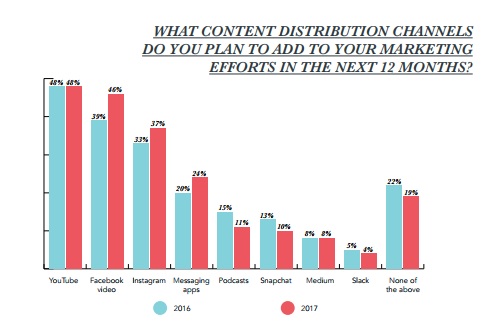
The more than 6,300 marketing professionals surveyed answered the following question: “What content distribution channels do you plan to add to your marketing efforts in the next 12 months?” The chart below shows responses from 2016 and 2017 surveys for comparison.
Source: State of Inbound 2017
Marketers will maintain or increase their investment on YouTube and Facebook video — focus on the latter jumping a significant 7% over 2016. Interest in Instagram and messaging apps has also grown significantly over the last year, while marketers’ investment in podcasts, Snapchat, and Slack has decreased.
I also want to note quickly that investment in Medium has remained steady at 8%. I plan to write more about Medium as an opportunity for supply chain and logistics businesses in the near future, so stay tuned!
Misaligned priorities
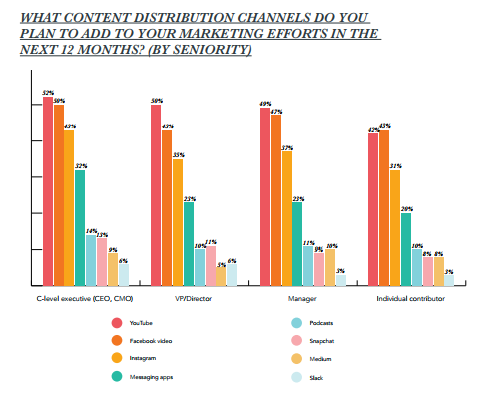
Another noteworthy aspect of this survey question is how respondents at various levels of the corporate ladder answered. Do the people who set company goals have the same priorities as those tasked with social media management and content distribution on a daily basis? Of course not! Take a look.
Source: State of Inbound 2017
Broken down by respondents’ roles, the data shows a division in the priorities of C-level executives versus individual contributors. Executives show a higher preference to expand to new channels of distribution such as messaging apps. The individual contributors responsible for the day-to-day oversight, however, offer a more conservative approach, favoring more tried-and-true distribution channels.
It is also interesting to note that individual contributors consider Facebook video a top priority slightly over YouTube, while executives, directors, and managers uniformly prefer YouTube.
Our takeaway: Video, video video
Across the board, companies are turning their content distribution focus to video platforms, and the supply chain should be, too. If you haven’t heard me say it before, I’ll tell you now: Yes, video can work for the supply chain.
Why? In a nutshell, YouTube reaches more adults ages 18-34 in the U.S. than any cable network. Users browse the platform for entertainment purposes, but also for tips, information, and ideas. And anywhere people are seeking solutions, businesses should be providing answers.
Live video, too, is a trend that is not going away anytime soon. According to the 2017 Social Media Marketing Industry Report, 61% of marketers plan on using live video services such as Facebook Live and Periscope, and 69% want to learn more about live video.
Live video helps businesses promote transparency, good communication, and relatability. It’s something that will do your business a world of good in the supply chain and logistics industries.
Related posts:

by Fronetics | Jun 13, 2017 | Blog, Content Marketing, Logistics, Marketing, Supply Chain
Follow these steps to equip your content writers with all the institutional knowledge and background information they need to create top-quality content.
Content drives consumers to your website, convinces them of the quality of your products/services, and ultimately helps convert those leads into customers. So, it goes without saying, the people writing your content are pretty important to your business.
Some companies rely on various employees, who are known to be good writers, to create their content. These people often struggle to fit writing into their full-time job, or don’t have SEO- or marketing-writing expertise. And if your business needs someone to produce many different kinds of content — like blog posts, emails, reports, articles for industry publications, and other marketing collateral — some non-writers will struggle with the versatility necessary to create it all.
Given that content is the backbone of a content marketing program, hiring a professional writer is crucial. Some companies, however, are nervous about finding content writers who are fluent in the technical language of their business. Or, they’re worried about the time it will take to get someone up to speed on all the ins and outs of the company and industry.
But here’s the thing: Great writing can’t be taught, but subject matter can. And it’s not as difficult as you might imagine. In fact, here are some best practices for turning your content writers into supply chain experts.
3 steps to make content writers supply chain experts
1. Teach them what they don’t know.
It’s easy for a content writer to conduct his or her own research to learn about industry topics, trends, terminology, and other concrete facts and news. But it’s less likely they’ll pick up on all the things that go unsaid in industry media and resources. That’s where you can help.
Provide your writer with information on all the landscape’s inner-workings. Consider answering these questions:
- Who are the key players in this space and why? Who are the most respected voices, and who are otherwise people to watch?
- How does this space make money?
- Who is the target buyer — demographics, pain points, strengths and weaknesses, etc.?
- What ideas are considered old-fashioned or taboo and why?
- What ideas are commonly accepted? Which are starting to become more accepted?
- What regulations or governing principles are relevant in this space?
- How does a company in this space measure success?
- What other internal politics or tidbits about institutional history would be helpful for someone to know?
2. Give them a watch list.
This goes hand in hand with the previous step, but it’s worth elaborating on. You want the writer to know the key players in the space so s/he can become familiar with the content and media your prospects are consuming.
Provide your content writer with a list of the thought leaders in the industry and where they are active (blogs or LinkedIn Pulse, for example); your competitors and their business partners or clients; and industry publications or media outlets that professionals in your business and your clients read on a regular basis. Who are the space’s must-follows on Twitter? Are there podcasts or newsletters that everyone in your line of business subscribes to? Do all of your industry peers receive some kind of publication?
A good writer will glean a lot of information from studying these people, businesses, and publications. They will also understand where the bar is set, and thus be able to strive to achieve that or exceed it in terms of value and quality.
3. Share your data.
The most successful writing teams I’ve ever been a part of have been well informed about business performance. Though writing is largely a creative process, it’s important that writers understand how their contributions are affecting the organization as a whole — whether that’s good news or bad news. They will feel more invested in the success of your organization, for one, but also it will help them adjust what they’re doing to accommodate what’s working and to eliminate what’s not.
You don’t have to get into the nitty gritty of financials, but some general information about how the company is performing is helpful for general knowledge. Otherwise, provide your writers with a regular report on the metrics you use to analyze the success of your content: pageviews, downloads, time on page, etc.
Follow these three steps, and you’ll ensure your writers are fully equipped to create informed, well-written content.
Related posts:


by Fronetics | May 24, 2017 | Blog, Content Marketing, Marketing
Ready to give up on content marketing? Chances are, you haven’t given it a fair shot.
You’re three or maybe even six months into your new content marketing program. Congratulations! You’re probably noticing an uptick in web traffic, social reach, and other engagement metrics like time on page. You’re right on track! But you have no leads or sales to speak of. And whether that’s got you nervous that you’re doing something wrong, or just has your boss breathing down your neck to get some results FAST, I’m here to tell you: Now is NOT the time to give up on content marketing.
In fact, giving up now is just about the worst thing you can do. You’ve already made the majority of the investment without giving your program time to deliver your return.
Why does content marketing take so dang long to work?
Content marketing is a long-term solution that helps businesses build brand awareness, grow their audience, and generate new leads and sales. But it takes time and effort to achieve results. You shouldn’t give up on content marketing before the seeds you sow have time to bear fruit.
Just how long will it take for your content marketing strategy to yield results? Well, that really depends on your business and your goals, but you can count on at least six months. (Joe Pulizzi, founder of the Content Marketing Institute, says more like 18.) The point is, content marketing is not a magic, overnight solution. The reason reflects why content marketing is effective in the first place.
4 reasons why it’s NOT time to give up on content marketing
1) Developing your strategy takes time.
Only 11% of companies without a documented content marketing strategy find their efforts to be successful, compared to 60% of companies with a strategy in place. (That number rises to 86% when the company designates someone to lead the strategy.) The significant increase in effectiveness can be attributed to the careful thought and research that goes into building a strategy.
You will need several months to build the foundation of your content marketing plan if it is to be effective. You need time to research the kind of content that resonates most with your audience and to truly understand the (very specific) demographic that finds value in what your company offers. Then you need time to determine and test which distribution channels will most effectively reach your target audience, to discern a plan for content production, and to build out an editorial calendar reflective of your strategy.
Without getting all of these pieces precisely right, you’ll waste an enormous amount of energy and resources working on an ineffective strategy. Take the time to evaluate the market for your business and its content marketing strategy, and you’ll realize results in time.
2) Becoming an authority takes time.
The goal of your content marketing efforts should be to be a consistent source of information and value to your audience, who gradually will come to trust your authority and reward you with their business when they are ready to make a purchase. And establishing yourself as an expert doesn’t happen overnight.
Consistency is key for two reasons. For one, the average B2B buyer consumes between two to five pieces of content before making a purchase decision. If your content is old, arbitrary, contradictory, or otherwise unreliable, buyers will chose a different vendor whose content is more trustworthy. Consistent and consistently good content keeps your target audience engaged and builds your credibility with them.
Secondly, search engines rank websites based on several factors, and one of the most important is consistency. If your company blogs every other month, compared to companies that post several days a week, your posts will be penalized in search results. And since very few readers click beyond the top five search results, you’re drastically reducing your organic search potential.
As a SumAll article put it, “Whether getting traffic to your blog or your content ranked in the search engines, it doesn’t happen overnight, but instead by repeatedly creating and distributing quality content on a frequent basis for the long-term.”
3) Building your audience takes time.
The B2B buying process is becoming longer and more complex because the majority of buyers (82%) are using more sources to research and evaluate products and services, and they are spending more time in the research phase itself. In fact, 71% of B2B researchers start with a generic search — rather than searching for a particular company — and do an average of 12 searches before even engaging with a specific brand’s site. They are 57% of the way down the sales path by this point, meaning they have already spent a fair amount of time educating themselves with the enormous amount of information available to them on the internet.
This means you need to allow your target audience time to find you and complete thorough research about you and your competitors before you even realize that the lead exists. And likely there will be more time before a sale takes place.
Content marketing is much more about lead nurturing than producing instant results. As you build your reputation as a valuable source of information, you will simultaneously build a loyal following of readers and content consumers who continue to return to you for knowledge and, ultimately, purchases. Relationship-building is not a streamlined process, but it does foster the ever-valuable repeat business that will have a greater impact on your bottom line than a one-and-done sale.
4) Your sales cycle takes time.
Unfortunately, content marketing cannot decrease the length of your sales cycle. Thus, you can’t expect to see the fruits of your labors (in terms of dollars) until at least one cycle is complete.
There should be, however, hints along the way that your efforts are working. Metrics like increased website traffic, email registrations, and social reach offer clues that more potential customers are finding your business in their research. You should take these signs and continually evolve your strategy to accommodate what is working for your business.
Also keep in mind that while content marketing can have an enormous impact on generating and nurturing leads, it does not deliver sales on a silver platter. Sales teams still play a major role in building on those relationships and closing deals.
Please don’t give up on content marketing before it’s had time to play out. You’ll not only lose out on your initial investment, but also all the leads and sales that will eventually come your way once your program has had time to develop fully.
Related posts:


by Fronetics | Apr 12, 2017 | Blog, Content Marketing, Marketing, Social Media
Interesting, original content is central to brand building for the supply chain and beyond.
What do Donald Trump, Kim Kardashian West, and Dan Rather have in common? Like ‘em or hate ‘em, they’ve each amassed an enormous organic following on social media. It doesn’t matter when or where they post it; these celebrities have proven that people will go out of their way to receive their content.
I came across an article the other day about the rising importance of the content creator that got me thinking about this. Joe Hyrkin, CEO of media company Issu, believes the age-old marketing debate about content vs. distribution is now a moot one. “Media consumers will change their behavior and go where a creator has produced interesting content,” he writes.
So many companies — supply chain, B2B, B2C, and beyond — spend an enormous amount of time and money trying to figure out the best places to distribute content and the best times to post. Don’t get me wrong: Those are incredibly important pieces of the puzzle. But I don’t think we can overemphasize the importance of the quality of your content and building a brand that reflects thought leadership.
In short, if you produce the kind of content that your target audience finds compelling, entertaining, and/or interesting, then you’re going to be successful.
“Interesting” is a matter of taste
You may roll your eyes at the idea that any of the above mentioned personalities qualify as “interesting content creators.” But that doesn’t matter — because a whole heck of a lot of people think they do.
The key for the content creator is, of course, inventing and creating for your specific audience.
Probably for your B2B business that doesn’t involve a scantily clad selfie or inflammatory tweet. But if you can be on the cutting edge of what does matter to your target audience, you’ll begin to build a brand that followers feel compelled to watch.
Speak your truth
We live in an interesting time for words like “true” and “fake.” But what I know to be important in content creation is authenticity.
Dan Rather offers an interesting case study. The 84-year-old veteran broadcaster’s rapid rise to social media stardom began with his candid election commentary on Facebook last November. Fans and critics alike have continued to engage with him via this platform. The resulting discussion can only be attributed to Rather’s authenticity — he shares what he truly thinks and feels, and encourages his followers to do the same.
Companies that use content and social platforms as an outlet for their missions, interests, and passions find greater success than those that are trying to be something they’re not in these spaces. For examples of companies who are doing it well, think of Coyote Logistics, Whole Foods, GoPro, Nike, Oracle, and Lowe’s.
Takeaway
The takeaway for the supply chain and other B2B companies is this: If you can build a brand with a reputation for creating really interesting original content, things like distribution, posting time, and posting frequency become less important.
People will know you as a source for cutting-edge ideas and thought leadership. People will be looking for your content. People will follow you because they care about what you have to say.
Don’t underestimate the power of quality original content.
Related posts: