Big data is big. Over the past two years alone more than 90% of the world’s data has been created. Each day more than 2.5 quintillion bytes of data are created. For those who are more numerically inclined that is more than 2,500,000,000,000,000,000 bytes per day.
Companies are spending big money to determine how they can harness the power of big data and drive actionable, practical, and profitable results. The International Data Corporation (IDC) recently forecasted that the Big Data technology and services market will grow at a 26.4% compound annual growth rate to $41.5 billion through 2018, or about six times the growth rate of the overall information technology market.
Weatherhead University Professor Gary King notes that: “There is a big data revolution, but it is not the quantity of data that is revolutionary. The big data revolution is that now we can do something with the data.” Herein lies the problem. Even as the quantity of big data being generated increases, and even as the money spent on big data increases, the majority of companies find themselves struggling to do something with the data. Companies are drowning in data while at the time being parched for information.
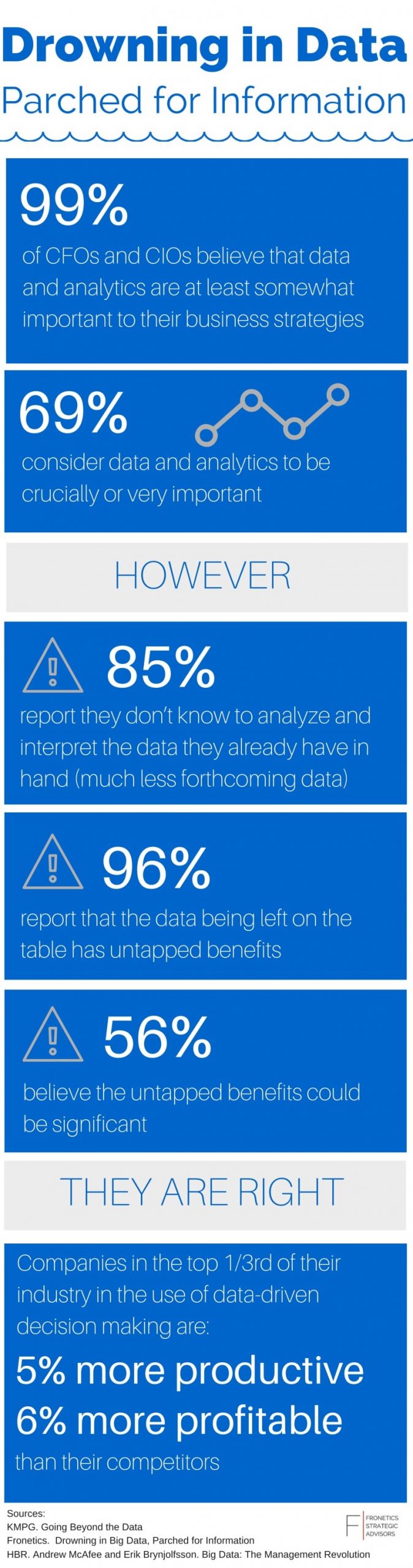
KPMG recently conducted a survey of 144 CFOs and CIOs with the objective of gaining a more concrete understanding of the opportunities and challenges that big data and analytics present. The survey found that 99% of respondents believe that data and analytics are at least somewhat important to their business strategies; 69% consider them to be crucially or very important. Despite the perceived value of big data, 85% of respondents reported that they don’t know to analyze and interpret the data they already have in hand (much less what to do with forthcoming data).
Moreover, 96% of survey respondents reported that the data being left on the table has untapped benefits. 56% of respondents believe the untapped benefits could be significant.
Research conducted by Andrew McAfee, co-director of the Initiative on the Digital Economy in the MIT Sloan School of Management, supports this belief. McAfee’s research found that “the more companies characterized themselves as data-driven, the better they performed on objective measures of financial and operational results.” Specifically, “companies in the top third of their industry in the use of data-driven decision making were, on average, 5% more productive and 6% more profitable than their competitors.”
Looking forward, companies that are able to effectively collect, analyze, and interpret data will gain a competitive advantage over those companies who are not able to do so.
A shipper used to Google "3PL in Atlanta" and click through ten websites. Now they…
The 10 questions to ask before hiring a supply chain marketing agency, plus red flags…
A step-by-step lead generation playbook for manufacturers: ICPs, buying committees, websites that convert, SEO, paid…
A practical SEO guide for 3PLs, freight brokers, and carriers: keywords, service and location pages,…
There's no shortage of supply chain content out there. The hard part is knowing which…
Editor's note: This post was originally published in June 2018 and has been updated for…